

Five policy signals from late October 2026 changed the denominator of the industrial heat pump business case — not the price of the machine.
Key takeaways
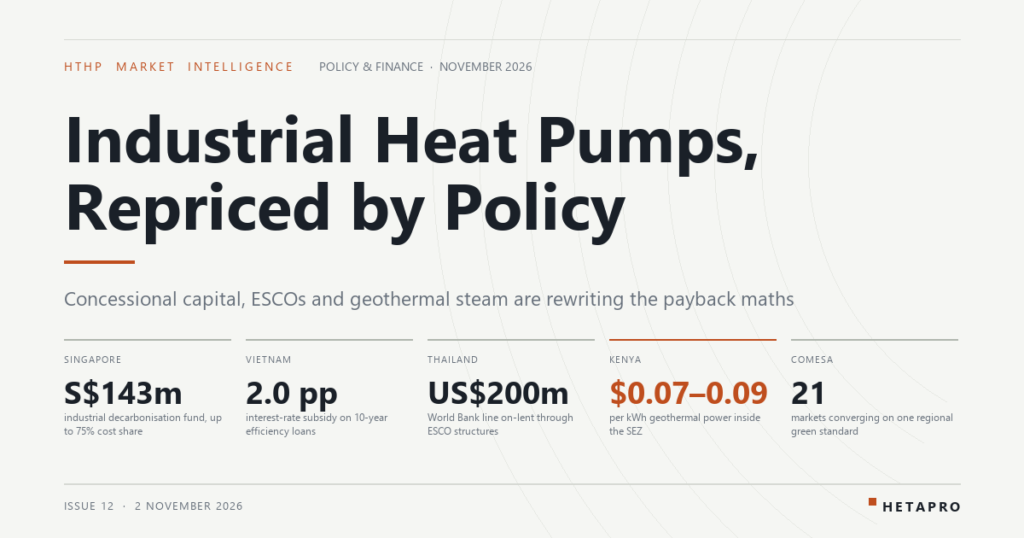
- Singapore committed S$143 million to industrial decarbonisation R&D on 23 October, with up to 75% of project cost covered under its new DRIVE programme and industrial heating electrification named as an eligible research direction.
- Vietnam drafted a VNĐ500 billion (≈US$19 million) energy-efficiency fund offering a 2-percentage-point interest subsidy, 10-year tenors and lending up to 70% of project cost — targeting operation from 1 January 2027.
- Thailand is channelling a US$200 million World Bank loan through EXIM Bank into ESCO-structured efficiency retrofits in industrial estates and public buildings.
- KenGen’s Olkaria Green Energy Park sells geothermal power at US$0.07–0.09/kWh and piped steam to tenants — horticultural heating costs fell 65% after diesel boilers were removed.
- COMESA is drafting a regional circular-economy fund that explicitly covers energy-efficient equipment, alongside harmonised green standards across 21 markets and 640 million people.
For most of the past three years, the business case for an industrial heat pump in Southeast Asia and Africa was argued in equipment terms: capital cost per megawatt of thermal output, coefficient of performance, refrigerant choice, lead time. That framing is now out of date. The five announcements reviewed below contain almost no purchase subsidies. What they contain instead are interest subsidies, risk-sharing grants, ESCO wrappers and administratively set energy tariffs — instruments that change the cash-flow curve of a project rather than its sticker price.
That distinction matters commercially. A grant reduces the numerator of a payback calculation once. A two-point interest subsidy or a 65% cheaper heat source changes the denominator for fifteen years. For anyone specifying a high-temperature heat pump in Vietnam, Thailand, Singapore, Kenya or the COMESA bloc, the procurement question in Q4 2026 is no longer “what does the unit cost” but “which capital stack does this project sit inside”.
Industrial heat pump vs high-temperature heat pump: the definition that decides your incentive
Definitions worth getting right before you file
Industrial heat pump (IHP): an electrically driven machine that recovers low-grade heat from process water, exhaust air, flue gas or wastewater and upgrades it to usable process heat. It is a category, not a temperature rating.
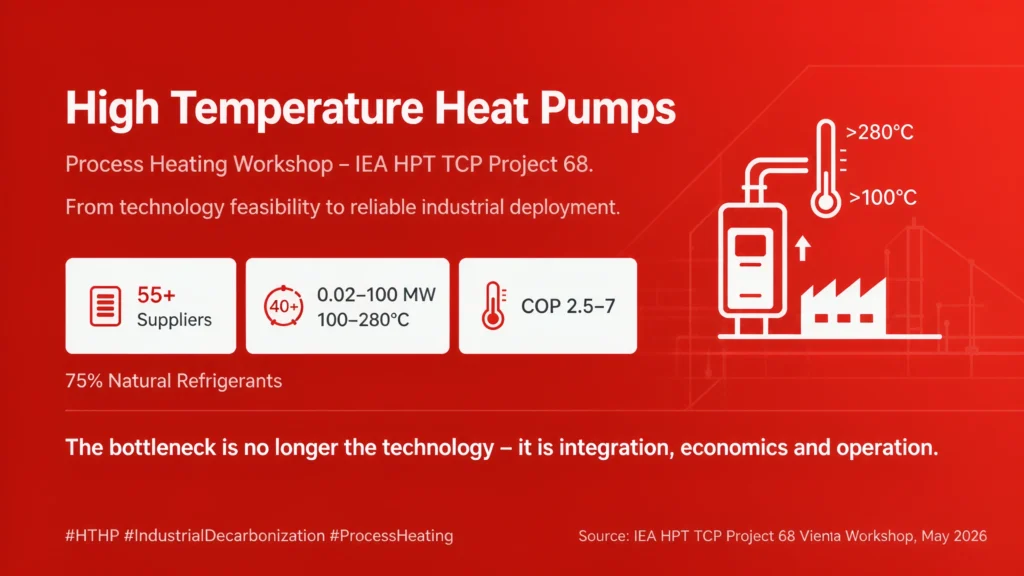
High-temperature heat pump (HTHP): the subset delivering supply temperatures above roughly 100 °C. Commercially proven platforms reach 120–200 °C — saturated steam to about 16 bar — with newer designs exceeding 200 °C. Typical COP is 2.5–4.0 in the 100–150 °C band, set by temperature lift rather than by catalogue headline figures.
Why the boundary is commercial, not academic: a growing number of incentive schemes, green-taxonomy definitions and utility rebates set a temperature floor at 80 °C or 100 °C. A unit specified at 95 °C to save capital cost can disqualify an entire project from a financing window. Size inside the threshold, then optimise.
A note on search terms: buyers who type high temperature heat pump without the hyphen are usually solving a 120–160 °C steam problem, not a hot-water problem. The distinction matters when you request a quotation: an industrial heat pump for steam generation is specified on steam pressure, dryness and feedwater quality, not on flow temperature alone — and those three parameters decide whether the quoted machine is a genuine HTHP or an upgraded hot-water unit.
The November 2026 shift: from subsidy to bankability
Three patterns run through this fortnight’s news, and they point in the same direction.
First, the instrument has changed. Vietnam’s draft fund subsidises the interest rate, not the invoice. Singapore funds up to three-quarters of the cost of proving a technology, not the cost of buying it. Thailand routes public money through an energy service company that carries the upfront capital. Kenya prices the energy carrier instead of subsidising the boiler replacement. Each design assumes the equipment is commercially available — which, for steam generating heat pumps I waste heat recovery systems in the 100–160 °C band, it now is.
Second, the eligible category has widened. Singapore’s DRIVE programme names industrial heating electrification alongside carbon capture and semiconductor abatement. COMESA’s proposed fund lists energy-efficient equipment as a qualifying investment. This is the difference between being classified as a “utility upgrade” and being classified as “decarbonisation infrastructure” — and it determines which pool of money a project can draw on.
Third, the geography has split into two models. Southeast Asia is running a financial-engineering model: concessional debt, ESCO structures, development-bank lines. Africa is running an energy-cost model: geothermal steam, industrial parks, regional standards. The two converge on a single test — can the host site replace a boiler without committing its own capital?
| Market | Instrument | Size | What it pays for | Effect on an HTHP project |
|---|---|---|---|---|
| Singapore | R&D cost-share grant (DRIVE) + shared testbed | S$143m programme; up to S$100m for DRIVE; 75% cost cover | Pilot and de-risk industrial heating electrification, carbon capture, semiconductor abatement | Removes first-of-a-kind risk from the supplier’s balance sheet; accelerates site trials |
| Vietnam | Interest-rate subsidy via commercial banks | VNĐ500bn (≈US$19m); 2 pp subsidy; 10-year tenor; 70% cap | Energy-efficient equipment, process upgrades, CBAM-driven retrofits | Cuts annual debt service, lifts DSCR, shortens equity payback by 6–12 months |
| Thailand | World Bank credit + ESCO delivery | US$200m; EXIM Bank on-lending; MOF guarantee | Industrial estate and public building efficiency, rooftop PV, electrical upgrades | Zero-capex entry for the host; ESCO owns the asset and the performance risk |
| Kenya | Administered energy tariff + steam supply | US$0.07–0.09/kWh; SEZ and customs-controlled status | Geothermal power, piped process steam, industrial land | Reduces delivered heat cost to ~US$7.4/GJ at COP 3.0 — roughly one-quarter of diesel |
| COMESA | Proposed regional fund + harmonised standards | 21 member states; 640m people; US$1.23tn GDP | Cleaner production, energy-efficient equipment, recycling infrastructure | Opens multi-country procurement; foreshadows regional MEPS for equipment |
Singapore: S$143 million, a 75% cost share, and a testbed on Jurong Island
At the first Singapore Industry Decarbonisation Forum on 23 October, Deputy Prime Minister and Minister for Trade and Industry Gan Kim Yong announced a S$143 million Industry Decarbonisation Funding Initiative. Up to S$100 million goes to DRIVE — Decarbonisation Research for Industry, Ventures, and Enterprise — under which companies define a production-level emissions problem, develop the solution with a public research institute, and recover up to 75% of eligible R&D cost. Applications opened the same day.
Two further allocations sit alongside it: S$65 million to scale five previously funded low-carbon energy projects into real industrial environments, and S$62 million for the Low-Carbon Technology Translational Testbed (LCT3) on Jurong Island, operated by A*STAR’s Chemical, Energy and Environmental Sustainability institute, with IHI Corporation, Amogy and Metha8 as first users.
The policy backdrop is what makes this relevant to industrial heat pump suppliers rather than only to research teams. Industry accounts for about 65% of Singapore’s emissions and manufacturing for roughly 20% of GDP. The carbon tax rose from S$25 to S$45 per tonne of CO2e in 2026 and is legislated to reach S$50–80 by 2030, with the post-2028 trajectory under review.
Run the arithmetic and the signal is modest but durable. Natural gas emits about 56.1 kgCO2 per gigajoule, so S$45/tonne is roughly S$2.5/GJ of gas consumed — about S$0.009 per kWh of thermal output. At the top of the 2030 range it approaches S$4.5/GJ. That will not finance an HTHP on its own. What it does is give a capital committee a legislated, rising cost line it can discount over ten years without betting on whether a grant programme survives the next budget.
Vietnam: a two-point interest subsidy is worth more than it looks
Vietnam’s Ministry of Industry and Trade is drafting a VNĐ500 billion (≈US$19 million) fund to finance energy-efficiency investment, channelled through credit institutions rather than handed out as grants. The terms, as reported by Vietnam News:
- Interest-rate subsidy of up to 2 percentage points per year.
- Loan tenors up to 10 lat, with grace periods up to 2 years.
- Lending capped at 70% of total project investment.
- Initial capital from the state budget over 2027–2029; submission to the Prime Minister planned for December 2026; operation from 1 January 2027 if approved.
The stated rationale is unusually direct: exporters face stricter carbon requirements in international markets, including the EU’s Carbon Border Adjustment Mechanism, and cannot secure financing to turn efficiency studies into installed projects. The Southeast Asia Energy Transition Partnership will support the ministry from September 2026 to August 2027 on investment potential and financing mechanisms.
Why a two-point subsidy punches above its weight: on a US$1 million, seven-year amortising loan, a 2-point reduction in the rate is worth roughly US$60,000–75,000 in nominal interest — about 6–8% of equipment capex — and it lands in the years when the project’s cash flow is thinnest. It also changes the credit conversation. A plant with a 70%-levered high-temperature heat pump project and a debt-service coverage ratio that clears the bank’s threshold gets approved; the same project without the subsidy frequently does not.
Layer this on Vietnam’s existing green credit framework and its pilot emissions trading system — 110 facilities in power, steel and cement under a 268.4 MtCO2e cap for 2026 — and the country now offers three stacking instruments: cheap debt, a green label, and a monetisable reduction. Waste-heat-recovery industrial heat pump projects with device-level metering are the natural fit, because they generate the verified data all three instruments require.
Thailand: the ESCO wrapper finally reaches the industrial estate
Thailand has secured a US$200 million World Bank loan, on-lent through the Export-Import Bank of Thailand with a Ministry of Finance guarantee, to fund clean energy investment and low-carbon city development. The first tranche targets public buildings and industrial estates in Bangkok and areas administered by the Industrial Estate Authority of Thailand, covering rooftop solar, electrical system upgrades and public lighting.
The delivery model is the important part. Projects are structured through energy service companies: the ESCO fronts the capital, installs the equipment, and is repaid from a share of verified energy savings over the contract term. The host carries no upfront capital expenditure, and performance risk sits with the party best able to manage it.
This is the single most transferable mechanism in this month’s set. Thailand separately approved a ฿50 billion residential rooftop solar subsidy on 27 October — up to ฿50,000 per household, 2.5% seven-year loans, ฿2.20/kWh export credit, registration from November — which tells you the government is comfortable using subsidised credit at scale. For industrial buyers, the ESCO line is the relevant one: an industrial heat pump system replacing a fuel boiler is a textbook ESCO asset, because savings are measurable at the meter and the equipment life comfortably exceeds a seven-year contract.
Kenya: when the energy carrier gets cheap, the heat pump case builds itself
KenGen’s results briefing on 29 October confirmed that its Green Energy Park at Olkaria has secured special economic zone status and designation as a customs-controlled area. The park bundles three things that are usually sold separately: geothermal electricity, piped process steam, and industrial land. Target tenants are food processing, manufacturing and data centres.
The numbers are the story. Industrial tenants can contract power at US$0.07–0.09/kWh, against commercial grid retail tariffs reported above US$0.15/kWh. Commercial rose and vegetable growers around Lake Naivasha already take low-pressure steam directly into greenhouses; reported results include a 65% reduction in heating cost, A 40% reduction in fungicide use and complete elimination of diesel boiler fuel, with monthly savings in the millions of Kenyan shillings.
KenGen invested KSh15.5 billion (≈US$120 million) in power infrastructure in the year to June 2026, up 14.3%, supplied 8,975 GWh to the grid — 57.2% of national demand — and completed rehabilitation of Olkaria I, lifting it from 45 MW to 60.5 MW. National peak demand stands at 2,549 MW. The park also plans geothermal-steam-driven absorption chilling for data centre cooling, displacing electric compressors entirely.
Why this reorders the African business case
The standard objection to process heat electrification in Africa is that electricity is expensive and fuel is not. At US$0.08/kWh and a COP of 3.0, delivered heat costs about US$7.4/GJ. A diesel boiler at US$0.95/litre and 85% efficiency delivers heat at roughly US$31/GJ. That is a four-to-one ratio with no subsidy, no carbon price and no grant — which is precisely why it is more durable than an incentive.
| Electricity price | COP 2.5 | COP 3.0 | COP 3.5 | vs diesel boiler* |
|---|---|---|---|---|
| US$0.05/kWh (Kenya SEZ, low end) | 5.56 | 4.63 | 3.97 | −82% to −87% |
| US$0.08/kWh (Kenya SEZ, high end) | 8.89 | 7.41 | 6.35 | −71% to −80% |
| US$0.12/kWh (Vietnam, Thailand industrial) | 13.33 | 11.11 | 9.52 | −57% to −69% |
| US$0.18/kWh (island / weak-grid sites) | 20.00 | 16.67 | 14.29 | −35% to −54% |
*Diesel at US$0.95/litre, LHV 35.8 MJ/litre, boiler efficiency 85% → ≈US$31/GJ thermal. Figures exclude integration cost, electrical upgrade and O&M.
Note what the table implies for specification. At US$0.18/kWh, moving from COP 2.5 to 3.5 cuts delivered heat cost by 29%; at US$0.05/kWh the same COP gain saves only 29% of a much smaller number. In cheap-power markets, capital cost and uptime dominate; in expensive-power markets, COP at the actual lift dominates. Quoting a single catalogue COP to both is how projects get mis-sized.
COMESA: the next barrier will be a standard, not a tariff
The Second COMESA Green Industries Connect meeting opened in Harare on 19 October, ahead of the 25th COMESA Heads of State Summit. Secretary-General Chileshe Kapwepwe framed green and circular industry as “a core threshold” for market access, investment attraction and regional competitiveness across a bloc of 21 member states, roughly 640 million people and a combined GDP near US$1.23 trillion.
Zimbabwe’s Minister of Industry and Commerce, Mangaliso Ndlovu, proposed a COMESA Circular Economy Fund with transparent eligibility criteria, explicitly covering cleaner production, energy-efficient equipment, recycling infrastructure and waste-to-value projects. He also called for aligned green standards, coordinated product testing and stronger conformity assessment to cut compliance costs across borders — the standard prelude to mutual recognition.
The forum focused on leather, textiles, plastics and electronic waste, with EU and German co-funding through the SWITCH to Circular Economy programme, implemented by Expertise France and GIZ. Delegates also warned that the energy transition will generate its own waste stream — PV modules, inverters, batteries — and that energy-efficiency labelling and minimum performance standards (MEPS) for appliances must be paired with collection and treatment systems.
Read the fund proposal and the standards language together and the direction of travel is unambiguous. Regional industrial decarbonization policy in Eastern and Southern Africa is moving from voluntary programmes toward eligibility rules: which equipment qualifies for concessional finance, which test standard it must pass, and which conformity mark travels across borders. That is a different kind of barrier from a tariff, and a harder one to argue with at the port.
For equipment exporters this is a 12–24 month window, not a current obligation. No threshold, test method or effective date has been published. But the direction is unambiguous, and the sectors named — leather, textiles, food processing — are exactly where pompy ciepła wysokotemperaturowe do their most standard work: dyeing at 130 °C, drying at 120–160 °C, tanning and finishing in the 60–90 °C range. Once a regional test standard exists, technical parameters migrate into procurement documents, and suppliers who participated in the consultation will have specified the parameters their machines already meet.
The 2026 industrial heat pump payback equation
Three of the variables above moved in the buyer’s favour this fortnight, and none of them is the CAPEX term. Vietnam reduced the effective cost of debt. Thailand removed the host’s capital outlay entirely. Kenya reduced the electricity price per gigajoule. Singapore reduced the cost of proving the design works. That is why headline equipment prices are a poor proxy for project economics in this region right now.
Industrial heat pump payback: the three variables that decide it
Strip away the policy detail and an industrial heat pump payback period is set by three numbers: the electricity-to-fuel price ratio, the COP at the real temperature lift, and annual operating hours. Everything else — refrigerant, controls, footprint, brand — is second order. A site with a 4:1 fuel-to-power ratio and 6,000 operating hours will repay in under three years almost regardless of who built the machine; the same industrial heat pump system installed where the plant runs 2,000 hours a year may never repay. That is how an identical 500 kW unit becomes a compelling investment in Naivasha and a stranded asset in a low-utilisation factory.
Worked example: 3 MWth steam replacement, Kenya SEZ
Assume 3 MW of saturated steam demand, 5,000 operating hours a year, 54,000 GJ of annual heat, an HTHP at COP 3.0 drawing most of its input from on-site waste heat, and a delivered power price of US$0.08/kWh. Diesel at US$0.95/litre and 85% efficiency costs about US$1.68 million a year in fuel. The heat pump consumes roughly 5,000 MWh of electricity, about US$400,000. Gross saving: US$1.28 million a year. Against an installed cost near US$2.3 million including integration and electrical works, simple payback is about 1.8 years — before any carbon revenue and before the tariff differential widens.
Run the same project on a Vietnamese grid tariff of US$0.12/kWh against LPG at US$17.9/GJ delivered heat, and payback stretches to roughly 4 years — cut to about 3.6 years once the draft 2-point interest subsidy is priced in. Same machine, same COP, radically different answer. Which is the point: industrial heat pump economics in emerging markets are a site-specific calculation, and any supplier quoting a generic payback is guessing.
What buyers, EPCs and suppliers should do before Q1 2027
- Map the capital stack before the equipment list. In Vietnam, sequence the draft fund (from January 2027) with green credit and the pilot ETS. In Thailand, approach an ESCO before approaching a vendor. In Singapore, scope a DRIVE-eligible measurement programme alongside the installation.
- Specify temperature, not just tonnage. Confirm whether the applicable scheme sets a floor at 80 °C or 100 °C, and whether “heat pump” is defined to include steam-generating units. A 5 °C shortfall can cost the whole incentive.
- Meter at the device. Every instrument in this article — interest subsidy, green credit, carbon revenue, ESCO settlement, Article 6 monetisation — requires verifiable operating data. Sub-metered electricity input, heat output, runtime and part-load behaviour should be in the scope of supply, not an afterthought.
- Price the carbon line explicitly. At S$45/tonne Singapore’s carbon cost is small; at S$80 it doubles; in South Africa’s Phase 2 trajectory it compounds annually. Show the line separately in the financial model so the buyer sees it rising.
- Enter the standards conversation early in Africa. COMESA’s fund and standards work is at the design stage. Participation now is cheaper than certification later, and it is how a supplier’s existing specification becomes the regional baseline.
- Do not confuse a pilot with a reference. A 75%-funded trial at LCT3 or a single greenhouse steam connection is a credential, not a track record. Pair it with 12 months of operating data before quoting it in a tender.
Frequently asked questions
What is the difference between an industrial heat pump and a high-temperature heat pump?
An industrial heat pump (IHP) recovers low-grade waste heat and upgrades it to usable process heat; a high-temperature heat pump (HTHP) is the subset supplying above roughly 100 °C, typically 120–200 °C and up to about 16 bar of steam. Every HTHP is an IHP, but not every IHP is an HTHP — and because many incentives set an 80 °C or 100 °C floor, the distinction decides eligibility as well as engineering.
How long is the payback period for an industrial heat pump in Southeast Asia?
For a well-integrated unit replacing LPG, diesel or fuel oil at 4,000–6,000 operating hours a year, simple payback in Vietnam, Thailand, Indonesia and the Philippines generally lands between 3 and 5 years before incentives and 2 to 4 years after concessional finance. The dominant variables are the electricity-to-fuel price ratio and the COP at the real temperature lift — not the purchase price.
Does Vietnam subsidise energy-efficient equipment such as heat pumps?
Not yet through a direct grant. A draft VNĐ500 billion (≈US$19 million) fund would provide preferential loans with interest subsidies of up to 2 percentage points, tenors to 10 years, 2-year grace periods and a 70% project-cost cap. Submission to the Prime Minister is planned for December 2026, with operation from 1 January 2027 if approved. Vietnam’s green credit framework and pilot ETS can be layered on top.
How does Singapore’s carbon tax change HTHP economics?
At S$45/tonne, the carbon cost embedded in natural gas is roughly S$2.5/GJ; at S$80/tonne it approaches S$4.5/GJ. That is not sufficient on its own to fund a conversion, but it is legislated and rising, which lets a capital committee model it over ten years without assuming a subsidy survives. The larger near-term lever in Singapore is the 75% R&D cost share, which de-risks the demonstration phase.
Can geothermal steam replace a diesel boiler in Kenya?
It already does. KenGen’s Green Energy Park at Olkaria pipes low-pressure geothermal steam to commercial horticulture around Lake Naivasha and to SEZ tenants, with reported heating-cost reductions of 65%, fungicide use down 40% and diesel fuel eliminated. Tenants can also buy geothermal power at US$0.07–0.09/kWh against grid retail above US$0.15/kWh, which makes an electric HTHP viable where steam is unavailable.
Do COMESA green standards apply to imported heat pumps today?
No. The October 2026 Harare meeting proposed a regional circular-economy fund covering energy-efficient equipment and called for harmonised standards and conformity assessment, with MEPS and energy labelling explicitly discussed. But no threshold or effective date has been published. Treat it as a 12–24 month regulatory window and engage in the consultation rather than waiting for the gazette.
Conclusion: the machine is the easy part
The technical case for a high-temperature heat pump in the 100–160 °C band has been settled for several years: natural refrigerants dominate new platforms, COP of 2.5–4.0 is routine, and the bottleneck has moved from compressors to process integration, reliable waste-heat data and electrical capacity. What changed in late October 2026 is the financial architecture around that machine.
Singapore will pay three-quarters of the cost of proving an industrial heating design. Vietnam will subsidise the interest rate rather than the invoice. Thailand will let an ESCO own the asset so the factory owns nothing. Kenya will sell you heat at a quarter of what diesel costs. COMESA is preparing to make a regional standard the price of admission to 21 markets.
For buyers, the implication is to build the capital stack first and the equipment schedule second. For EPCs, it is to hire a project-finance lead before the next tender. For manufacturers of industrial heat pumps, it is blunter still: in this region, the supplier who can hand over a machine and a bankable model wins the procurement cycle — and the one who quotes only a price is competing on a variable that policy has stopped caring about.