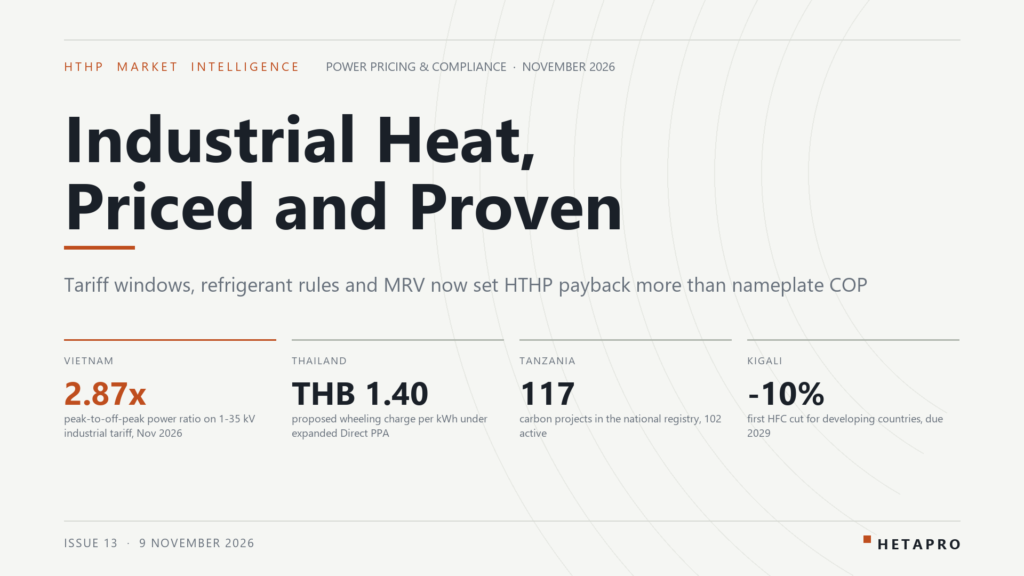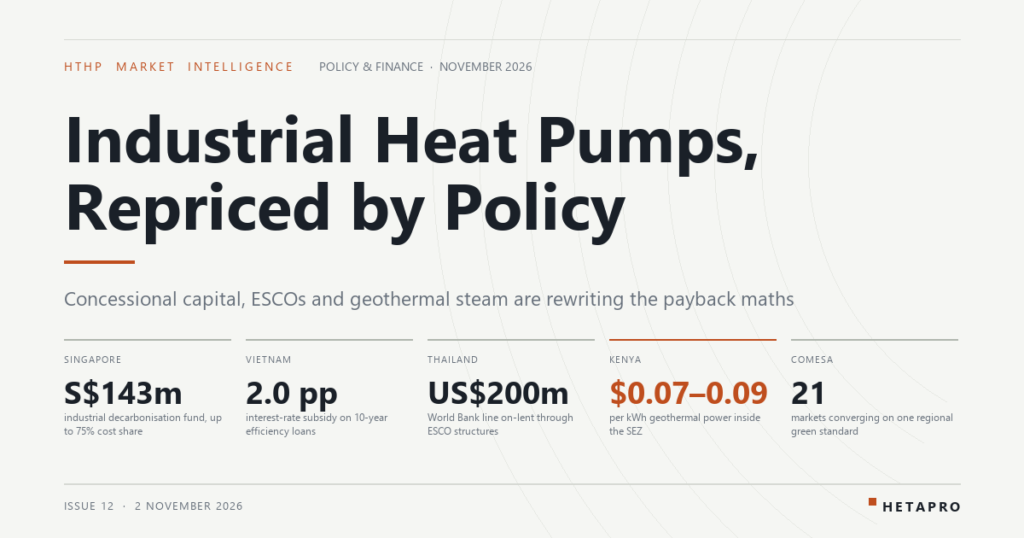

Industrial Heat Pumps, Priced and Proven: How Tariff Windows, Refrigerant Rules and MRV Now Set HTHP Payback
The equipment case is settled. What is not settled is the price of a kilowatt-hour at 19:00, and the price of a carbon claim you cannot document.
Key takeaways
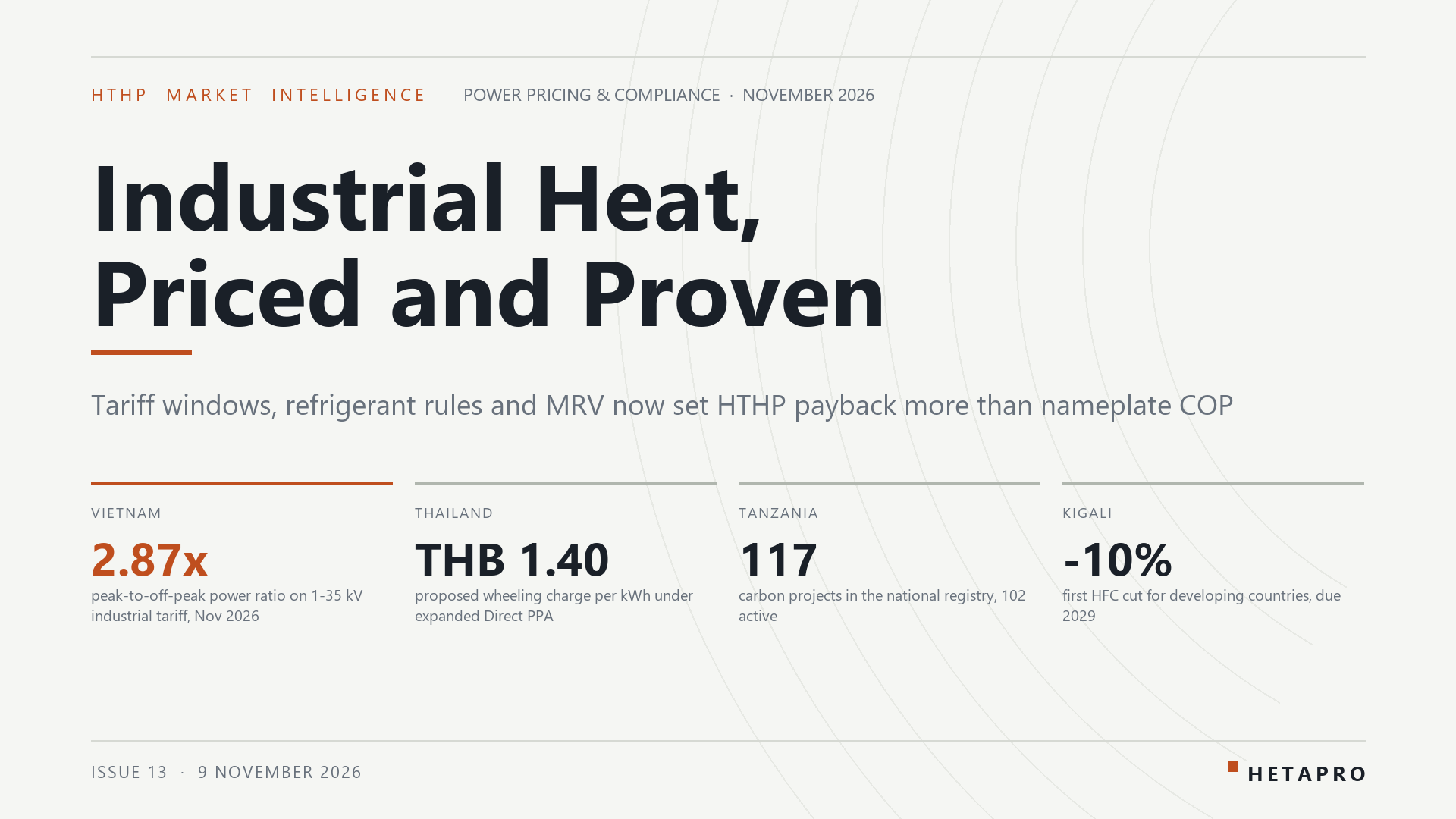
- Vietnam’s industrial tariff from 1 November 2026 delivers a 2.87x peak-to-off-peak ratio at 1–35 kV — VND 3,348 against VND 1,166/kWh — with peak hours moved to 17:30–22:30 and off-peak to 00:00–06:00.
- Thailand opened Direct PPAs to all industries on 4 November, with a proposed wheeling charge near THB 1.40/kWh and data centres reclassified to bear their own LNG import cost.
- في MOP38 in Kigali (2–6 November), the tenth anniversary of the Kigali Amendment framed the next test: developing countries begin cutting HFCs by 10% in 2029, which puts R245fa-based HTHPs in the service-risk bracket.
- UNDP’s 5 November assessment of African carbon markets names MRV capacity and Article 6 authorisation — not project supply — as the binding constraint; Tanzania now carries 117 registered applications.
- A 3 t/h steam conversion in Vietnam still repays in about 1.7 years, but the carbon reduction is closer to 21% than 80% unless the power is contracted green.
Every week for the past two years, the argument for an industrial heat pump has been made in the same currency: capital cost per kilowatt of thermal output, coefficient of performance, refrigerant, lead time. That argument is now largely won. In the 120–165 °C band, where process heat electrification meets real steam demand, commercially available machines perform as specified, and the engineering question has shifted from “can it be done” to “will it be paid for”.
This week’s news suggests the payment question has quietly changed shape. The five developments below contain almost nothing about equipment. They are about when electricity is cheap, what refrigerant is legal to refill, and what evidence a carbon claim requires. Each one moves the heat pump payback calculation — but through a different variable, and at a different point in the project’s life.
The unifying insight is uncomfortable for suppliers: two of the three new variables are invisible on a quotation sheet, and one of them only bites in 2029. A buyer comparing two high-temperature heat pump offers on price and COP is therefore comparing the two things that matter least.
Five signals from the first week of November 2026
1. Kigali’s tenth birthday, and the 2029 cliff
The 38th Meeting of the Parties to the Montreal Protocol convened in Kigali, Rwanda, from 2 to 6 November — returning to the city where the Kigali Amendment was adopted in 2016. The anniversary produced a joint statement from the Environmental Investigation Agency and eleven civil-society partners that is worth reading as a compliance document rather than a celebration. Its asks are specific: stronger licensing systems, action against illegal trade in refrigerants and cooling equipment, tighter controls on HFC-23 emissions, and exploration of faster HFC reductions than the treaty schedule requires.
The schedule itself is what matters commercially. Developing countries froze HFC consumption in 2024 against a 2020–2022 baseline and must deliver their first 10% cut in 2029, then 30% by 2035, 50% by 2040 and 80% by 2045. China — the source of most industrial heat pump tonnage sold into Southeast Asia and Africa — has applied total-quantity control since 2024 and confirmed the same 2029 step in a Ministry of Ecology and Environment briefing published on 1 November, alongside a push to scale R290 and CO2 alternatives and tighten enforcement against illegal production and trade.
Why it matters: the HFC basket is not an abstraction for a 150 °C heat pump. The workhorse refrigerant for that temperature band, R245fa, has a GWP of 858. R134a, still used in cascades, is 1,430. Both are inside the controlled basket. From 2029, refrigerant supply in Article 5 countries becomes a quota-constrained market with a licensed import channel — and a machine whose refrigerant cannot be legally imported cannot be serviced, whatever its COP.
2. Vietnam rewrote the clock, not just the price
Decision 2892/QĐ-BCT, signed on 31 October and effective 1 November 2026, cut Vietnam’s average retail electricity price by about 2% to VND 2,159.90/kWh. That headline is the least interesting part. For industrial customers supplied at 1–35 kV, the new schedule is VND 1,814/kWh in normal hours, VND 1,166/kWh off-peak and VND 3,348/kWh at peak, excluding VAT — a peak-to-off-peak ratio of 2.87 and a 35.7% discount for night operation.
More consequential still is Decision 963/QĐ-BCT, which replaced Vietnam’s split morning and evening peaks with a single evening block of 17:30–22:30, Monday to Saturday, and moved off-peak to 00:00–06:00. Sundays carry no peak period at all. The two windows are almost complementary: six hours to charge, five hours to discharge, six days a week. That is an unusually clean arbitrage geometry, and it was clearly designed with storage in mind.
Why it matters: a 24/7 steam plant now spends 21% of its hours in the most expensive block of the Vietnamese day, and another 25% in the cheapest. Whether the high-temperature heat pump is specified as a baseload machine or a dispatchable one has become an economic decision with a measurable answer — which is exactly what the next section calculates.
3. Thailand lets industry buy its own electrons
On 4 November, Thailand’s energy minister set out an energy reform roadmap at a Bangkok economic forum. Three elements bear on industrial heat. First, data centres will be created as a separate consumer class (class 9) required to carry the cost of the LNG imported to serve them, rather than socialising it across the existing gas pool. Second, the Direct PPA mechanism — previously a 2,000 MW sandbox limited to data centres — is being extended to other industries that need clean power, with the regulator still to settle third-party access pricing, discussed at roughly THB 1.40/kWh, plus an imbalance charge. Third, the clean-energy share of generation is targeted to rise from about 20% to 50% within a decade and beyond 65% after that, with the national utility repositioned as a network operator.
Why it matters: for a Thai factory running an industrial heat pump, this is the first credible route to contract the emissions attribute of its electricity rather than merely buying kWh. It is also a signal about cost-reflective pricing — if large users increasingly bear the true cost of the energy they consume, then efficiency stops being a sustainability line item and becomes a procurement hedge. The wheeling charge is the number to watch: at THB 1.40/kWh it is a material adder, and it determines whether a PPA beats the retail tariff for a given load shape.
4. Africa’s carbon market problem is measurement, not ambition
On 5 November, UNDP published Africa’s Carbon Market Resilience amid Geopolitical Shifts, assessing country readiness, pipeline integrity and institutional capacity across the continent. Its conclusion is pointed: the constraint on African carbon finance is not the absence of projects but the capacity to measure, report and verify them, alongside national institutions able to authorise Article 6 transfers and defend environmental integrity.
Tanzania’s numbers show what that looks like in practice. At the national carbon market forum in Dar es Salaam in late October, the National Carbon Monitoring Centre reported 117 project applications in the registry, of which 102 are ongoing; roughly 70 are listed with Verra, Gold Standard or Plan Vivo, and about 35 have been registered or validated. The government has budgeted over TZS 5 billion for registry and institutional systems, set a six-month deadline for state-owned enterprises to embed emission-reduction components into their projects, and is completing Article 6 guidelines.
Why it matters: industrial waste-heat recovery is one of the few project types in Africa that produces a measurable, verifiable energy quantity at a single meter. That makes it structurally attractive to buyers — but only if the monitoring exists. A heat recovery project designed without device-level metering is, for carbon purposes, indistinguishable from a claim.
5. Vietnam pushes credit approval down to the province
Decree 396/2026/ND-CP, issued on 26 October and effective 12 December 2026, decentralises Vietnam’s domestic carbon credit procedures. Registration, adjustment, changes of project participants, cancellation and credit issuance move to the chairman of the relevant provincial People’s Committee. The dossier requires a project design document, a monitoring plan and a sustainable development plan; there is a three-working-day validity check, a 22-working-day public consultation, and a ten-working-day decision window on issuance once opinions are received. Projects spanning provinces must coordinate across them.
Why it matters: administrative distance is a real cost in project finance. A waste-heat recovery project that previously waited on a national queue can now be processed where the factory stands, which shortens the path from installation to an issued credit — and makes the credit bankable earlier in the asset’s life. The consultation period also means the timeline should be modelled at the start, not discovered at the end.
| Market | Instrument | Key number | What it changes | Action for an HTHP project |
|---|---|---|---|---|
| Global (Kigali) | HFC phase-down under the Montreal Protocol | −10% from 2029 for Article 5 parties | Refrigerant supply, import licensing, serviceability of installed equipment | Specify GWP ≤ 150 with a named refrigerant and a service plan |
| Vietnam | Industrial tariff and time-of-use restructuring | VND 1,166 / 1,814 / 3,348 per kWh; peak 17:30–22:30 | Value of load shifting; case for storage and dispatchable operation | Model the heat load hour by hour, not as an annual average |
| Thailand | Direct PPA extended beyond data centres | Wheeling ≈ THB 1.40/kWh (proposed) | Ability to contract clean power and a fixed price | Price a PPA against retail before fixing the heat pump size |
| Africa (UNDP) | Carbon market readiness and integrity | MRV named as the binding constraint | Bankability of carbon revenue on heat recovery | Put sub-metering in the scope of supply, not the retrofit list |
| Vietnam | Decree 396/2026 on carbon credits | Effective 12 December 2026 | Speed and locus of credit approval | Build a 22-working-day consultation into the project schedule |
The definitions that decide the next three years
Four terms used precisely
Industrial heat pump (IHP): an electrically driven machine that recovers low-grade heat from process water, exhaust air, flue gas or wastewater and upgrades it to usable process heat. A category, not a temperature rating.
High-temperature heat pump (HTHP): the subset supplying above roughly 100 °C. Proven platforms reach 120–200 °C, or saturated steam to about 16 bar; COP is typically 2.5–4.0 in the 100–150 °C band and is governed by temperature lift, not by the headline figure on a datasheet.
Global warming potential (GWP): the 100-year warming effect of one kilogram of a refrigerant relative to CO2. R245fa is 858, R134a 1,430, R32 675, R410A above 2,000. R1233zd(E) and R1336mzz(Z) are around 1–2; R718 (water) and R744 (CO2) are 0 and 1.
MRV: measurement, reporting and verification — the evidence chain that converts an emission reduction into an instrument someone will buy. For industrial heat it begins with a meter on the heat pump’s electrical input and thermal output, and ends with a verifier’s signature.
Gate one: the refrigerant inside the box
Refrigerant selection used to be an engineering trade-off between pressure, volumetric capacity and efficiency. It is now also a regulatory bet on the availability of a fluid in 2032. The Kigali schedule makes that concrete: a 10% cut in 2029, 30% by 2035, 80% by 2045, applied to a national quota that shrinks while demand for cooling grows.
For the 120–165 °C band that process heat electrification targets, the practical options are narrower than datasheets suggest. R245fa remains the default for single-stage machines to about 140–150 °C and is the fluid most widely supported by service networks in Asia — and it is also the one most exposed. R1233zd(E) and R1336mzz(Z) deliver similar temperatures at GWP near 1–2, but at low pressure, which means larger swept volume, larger pipework and a higher capital cost per kilowatt. R718 (water) is the natural-refrigerant answer above 150 °C, typically implemented as mechanical vapour recompression, and it is the only option with no phase-down exposure at all — at the cost of very high volumetric flow and a compressor architecture that many suppliers cannot yet offer. R744 (CO2) is excellent to about 90 °C and workable to 120 °C, then loses efficiency quickly as lift rises.
| مادة التبريد | GWP100 | Safety class | Practical supply temp. | Commercial read | Phase-down exposure to 2036 |
|---|---|---|---|---|---|
| R245fa | 858 | A1 | 120–150 °C | Cheapest per kW, widest service base, best volumetric capacity | High — inside the HFC basket; quota-constrained supply and refill risk |
| R1233zd(E) | ≈1 | A1 | 120–165 °C | Low pressure, large swept volume, higher capex; strong European reference base | Low — but HFO degradation products are under PFAS scrutiny |
| R1336mzz(Z) | ≈2 | A1 | 130–170 °C | Highest critical temperature of the HFOs; suited to two-stage steam duties | Low — same PFAS caveat as other HFOs |
| R718 (water) | 0 | A1 | 150–200 °C+ | MVR architecture, very high volume flow, few suppliers, best long-run regulatory position | None — not a controlled substance |
| R744 (CO2) | 1 | A1 | 90–120 °C | High pressure (120–160 bar), efficiency falls sharply at high lift | None — natural refrigerant |
There is a second, less discussed risk: illegal trade. The Kigali joint statement devotes attention to unlicensed refrigerant and equipment movement precisely because enforcement is uneven, and because a discounted machine with an undeclared charge is attractive to buyers who do not intend to service it locally. For a 15-year asset, that discount is a trap. Ask for the import licence reference for the refrigerant, not just the CE or ISO certificate for the unit.
Gate two: the clock on the meter
Vietnam’s new schedule turns an annual electricity price into an hourly one, and that changes what an industrial heat pump should be asked to do. Take a plant with 2 MW of continuous steam demand. At VND 3,348/kWh the five evening peak hours cost 2.87 times what the same kilowatt-hour costs between midnight and six.
The tempting response is storage. The arithmetic is worth doing properly, because it is where most business cases quietly fail.
Thermal energy to shift out of the 5-hour peak = 5 h × 1,983 kWth ≈ 9.9 MWhth
Charging at higher lift, COP 2.9 = 9,915 / 2.9 ≈ 3,419 kWhe
Peak-hour electricity displaced at COP 3.2 = 9,915 / 3.2 ≈ 3,098 kWhe
Cost with storage = 3,419 × 1,166 = VND 3.99 m/day
Cost without storage = 3,098 × 3,348 = VND 10.37 m/day
Net saving = VND 6.39 m/day ≈ US$243/day ≈ US$73,000/yr (300 peak days)
Break-even storage cost, 5-year payback = 364,500 / 9,915 ≈ US$37/kWhth
Break-even storage cost, 8-year payback = 583,000 / 9,915 ≈ US$59/kWhth
That is the honest verdict, and it is not the one most storage vendors will give you. Delivered cost for a 170 °C pressurised water store in Southeast Asia generally sits above US$50/kWh of thermal capacity once vessel, insulation, pumps and controls are included, so arbitrage alone rarely funds a tank sized for the full peak. It funds one when the tank is also removing a production constraint, absorbing surplus rooftop solar, or cutting a capacity charge.
| Strategy | Annual value | Incremental capex | When it works |
|---|---|---|---|
| Reschedule batch loads into 00:00–06:00 and Sunday | Up to US$73,000 | ≈ zero | Batch processes — dyeing, CIP, drying, pasteurisation — where the heat demand is not continuous |
| Full 5-hour thermal storage on continuous steam | ≈ US$73,000 | US$500k–900k | Only if storage is below ≈US$37/kWhth, or if it also relieves a bottleneck |
| 2-hour accumulator to shave the peak shoulder | US$25,000–35,000 | US$120k–200k | Plants with swing loads and a demand charge; improves dispatchability but not a standalone case |
| Rooftop PV self-consumption with the heat pump as daytime sink | Tariff-dependent; often the largest line | US$600–900/kWp | Sites with daytime load and roof area; the heat pump becomes the storage-free way to use your own electrons |
The wider point is that a high-temperature heat pump is now a dispatchable asset, and should be specified as one: part-load curve published, minimum turndown stated, ramp rate stated, and controls that accept an external price signal. A machine that only runs flat out is being operated against a tariff structure that punishes it five hours a day.
Gate three: the claim you can defend
The third variable is the least familiar to equipment buyers and the most likely to determine whether a project gets financed. Carbon revenue on an industrial heat project depends on an evidence chain, and that chain starts at the meter.
What a verifier will ask for is unglamorous: electricity consumed by the heat pump, measured separately from the rest of the plant; thermal energy delivered, measured on the steam or hot-water side; operating hours and part-load profile; the baseline boiler’s fuel consumption and efficiency, measured rather than assumed; and the refrigerant charge, because leakage is part of the inventory. A project that installs a 2 MW machine and reconstructs these numbers from utility bills after the fact will lose most of its claim to conservativeness factors.
Africa’s constraint is institutional rather than technical, which is why the UNDP finding matters for suppliers. If verification capacity is scarce, verifiers gravitate to project types with simple, standardised measurement — and a heat recovery system with a heat meter and a power meter is about as simple as industrial carbon accounting gets. Tanzania’s registry, with 102 active projects and a state-owned-enterprise mandate to embed emission reductions, is the kind of pipeline where a well-instrumented industrial project can be first rather than last.
Vietnam’s decentralisation under Decree 396/2026 changes the tempo rather than the substance. Provincial processing shortens the path, but the 22-working-day consultation and the requirement for a monitoring plan mean that the metering design has to be fixed before commissioning, not after. Budget the consultation period into the schedule and the credit arrives while the equipment is still under warranty.
What this does to a real payback calculation
Take a Vietnamese textile plant with 3 tonnes per hour of saturated steam at 5 bar(g), 8,000 operating hours a year, an LPG boiler at 88% efficiency and a waste-heat stream at 75 °C available from dyeing effluent.
Steam enthalpy, 6 bar abs, 90 °C feedwater = 2,380 kJ/kg ≈ 0.66 kWhth/kg
Annual thermal output = 3,000 kg/h × 0.66 × 8,000 h ≈ 15,900 MWhth
LPG at 88% efficiency = 15,900 / 0.88 / 12.8 kWh per kg ≈ 1,408 t/yr
Fuel cost at US$0.90/kg ≈ US$1.27 m/yr
HTHP electricity at COP 3.2 = 15,900 / 3.2 ≈ 4,960 MWhe
Blended tariff, 19 normal + 5 peak hours, Sunday exempt ≈ US$0.079/kWh
Electricity cost ≈ US$394,000/yr
Net saving after maintenance delta ≈ US$858,000/yr
Installed cost incl. waste-heat recovery and integration ≈ US$1.45 m
Simple payback ≈ 1.7 years
Two caveats deserve equal billing with the headline number, because both are where quotations tend to overreach.
The waste-heat dependency is real. At COP 3.2 the machine needs a 75 °C source. Remove it and an air-source unit at 32 °C ambient delivering 165 °C steam runs at COP 2.4–2.6, electricity consumption rises by a quarter, and payback stretches to about 2.4 years. That is still a good project — but it is a different project, and the quotation should state which one it is.
The carbon number is smaller than the sales deck. LPG at 1,408 tonnes a year emits roughly 4,140 tonnes of CO2. The heat pump’s 4,960 MWh carries about 3,270 tonnes at a grid factor of 0.66 tCO2/MWh. The reduction is roughly 21% — because Vietnam’s generation mix is still close to half coal. Claiming 70–80% on a coal-heavy grid is the fastest way to fail a CBAM questionnaire or an Article 6 review. The carbon case becomes compelling only when the electricity is contracted green: with a Direct PPA or renewable certificates, the same project approaches full abatement, and the cost saving and the carbon claim finally point the same way.
What buyers, EPCs and suppliers should do before Q1 2027
- Rebuild the load profile hourly. Annual average tariffs hide the 2.87x spread. Ask for 8,760-hour heat demand, mark the 17:30–22:30 and 00:00–06:00 blocks, and size the machine against the shape rather than the peak.
- Specify the refrigerant in the purchase order. A GWP ceiling, a named fluid, a stated charge per circuit and a service commitment through the phase-down. Treat R245fa as a transition choice that needs a written migration path.
- Publish the part-load curve. Dispatchable operation is now worth money. A supplier who cannot state turndown, ramp rate and COP at 50% load cannot support a time-of-use business case.
- Put sub-metering in the scope of supply. Separate power meter, heat meter, runtime counter and a data export that a verifier will accept. Retrofit metering costs more and weakens the claim.
- Price the power contract before the equipment. In Thailand, test a Direct PPA at the proposed THB 1.40/kWh wheeling charge. In Vietnam, test whether a 6-hour night window can carry the load without storage.
- Model the administrative clock. Vietnam’s 22-working-day consultation and ten-working-day issuance decision are known quantities; put them on the Gantt chart next to the commissioning date.
Frequently asked questions
What refrigerant should a high-temperature heat pump use after the Kigali phase-down?
For 120–165 °C, the defensible choices are R1233zd(E) و R1336mzz(Z) at GWP around 1–2, or R718 (water) where the duty suits vapour recompression. R245fa, still common in this band, has a GWP of 858 and sits inside the HFC basket that developing countries must cut by 10% from 2029. R744 (CO2) works to roughly 90–120 °C but loses efficiency at high lift. Specify a GWP ceiling, the charge per circuit and a service plan — from 2029 the refrigerant, not the compressor, decides whether a unit can be legally serviced.
How does Vietnam’s November 2026 tariff change industrial heat pump payback?
Decision 2892/QĐ-BCT cut the average retail price about 2% to VND 2,159.90/kWh, but structure matters more than the average. At 1–35 kV, industrial rates are VND 1,814 normal, VND 1,166 off-peak and VND 3,348 peak — a 2.87x spread. Peak hours moved to 17:30–22:30 Monday to Saturday, off-peak to 00:00–06:00, with no peak on Sunday. The lower average trims payback slightly; the wider spread instead rewards plants that can move load, which is a scheduling and storage question rather than an equipment question.
Is thermal storage worth installing to arbitrage time-of-use tariffs in Vietnam?
Usually not on arbitrage alone. Covering a five-hour peak on a 2 MW load needs about 10 MWhth. At a VND 2,182/kWh spread the saving is roughly US$243 per operating day, about US$73,000 a year. A five-year payback therefore needs installed storage near US$37/kWhth, an eight-year payback about US$59/kWhth — and delivered cost for a 170 °C pressurised store in ASEAN generally sits above that. Storage closes when it also removes a production constraint, cuts a demand charge, or absorbs surplus solar.
What is the payback period for a high-temperature heat pump replacing an LPG boiler in Vietnam?
For 3 t/h of saturated steam at 5 bar(g), 8,000 hours a year and LPG at US$0.90/kg with 88% efficiency, fuel cost is about US$1.27 million a year. An HTHP at COP 3.2 on 75 °C waste heat draws about 4,960 MWh of electricity, costing roughly US$394,000 at the November 2026 blended tariff. Net saving after maintenance is about US$858,000 against an installed cost near US$1.45 million: simple payback of about 1.7 years. Without waste heat, COP falls to 2.4–2.6 and payback moves towards 2.4 years.
Does an industrial heat pump cut carbon emissions in Vietnam if the grid is coal-heavy?
Far less than suppliers usually claim. At a grid factor of 0.66 tCO2/MWh, the 4,960 MWh above carries about 3,270 tonnes, against roughly 4,140 tonnes from 1,408 tonnes of LPG — a reduction near 21%, not 70–80%, because Vietnam’s mix remains close to half coal. The carbon case improves sharply only when the electricity is contracted green through a Direct PPA or renewable certificates, which is why power procurement and carbon accounting now belong in the same conversation as the heat pump specification.
How do African carbon markets treat industrial waste-heat projects?
With growing interest and limited verification capacity. UNDP’s November 2026 assessment names MRV capacity, national institutions and Article 6 authorisation as the binding constraints rather than project supply. Tanzania shows the direction: 117 registry applications, 102 ongoing, roughly 35 registered or validated, a TZS 5 billion budget for registry systems and a six-month deadline for state-owned enterprises to embed emission reductions. For a heat recovery project the consequence is simple — design the monitoring in at the outset, because a claim without device-level data has no buyer.
Conclusion: the quotation sheet is no longer the decision document
The technical case for a high-temperature heat pump in the 100–165 °C band has been settled for several years: COP of 2.5–4.0 is routine, steam generation is proven, and the real engineering risk lies in process integration and reliable waste-heat data rather than in compressors. What the first week of November 2026 changed is the set of conditions attached to the cash flows that machine produces.
Vietnam has made the hour of the day a first-order variable, and in doing so has made dispatchability a specification item. Thailand has given industrial buyers a route to contract the emissions attribute of their power, with a wheeling charge that will decide whether it beats retail. Kigali has put a date on the refrigerant — 2029 — which converts a technical preference into a balance-sheet liability for anyone still specifying R245fa without a migration path. African carbon markets, per UNDP, need measurement more than ambition, which rewards the project that instruments itself. And Vietnam’s Decree 396/2026 has shortened the administrative distance between a factory gate and an issued credit.
For buyers, the sequence is now power contract, then refrigerant, then machine. For EPCs, it is metering in the scope of supply and a part-load curve in the tender. For manufacturers of industrial heat pumps, the message is blunt: a quotation that states price and COP is answering questions the market stopped asking. The supplier who can also state the GWP, the part-load behaviour and the evidence chain is the one whose machine gets financed.
That is what “priced and proven” means in this region now. The heat is easy. The proof is the product.