

Key takeaways
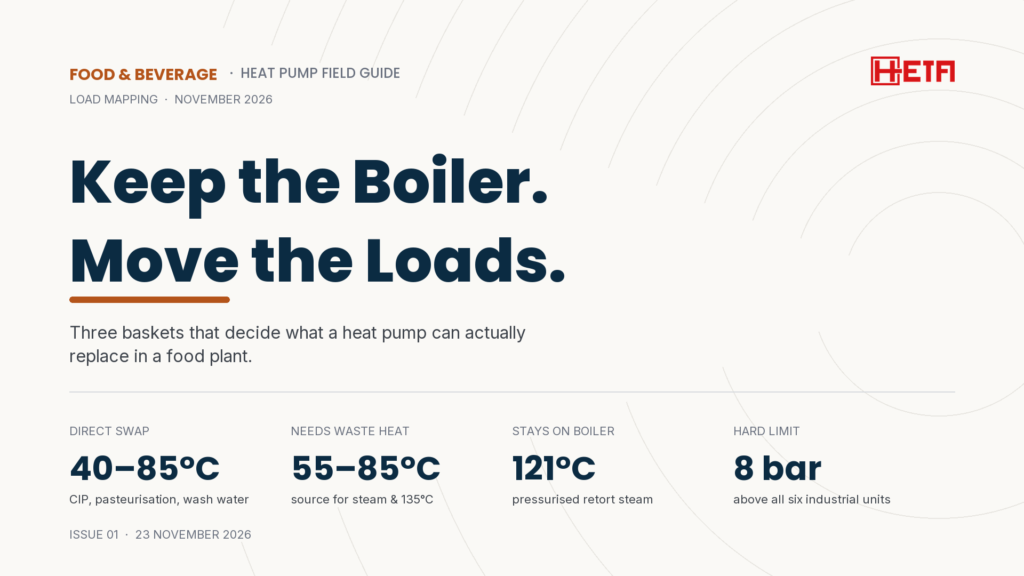
- The boiler still firing is usually a correctly scoped retrofit, not a failed one — it now covers only the loads a heat pump cannot take.
- Loads at 40–95°C (CIP, pasteurisation hot-water loops, washing, low-temperature drying) can move to ambient-air heat pumps with no waste-heat source.
- Steam at 110–150°C and 135°C hot water need a 55–85°C waste-heat stream — no stream, no route.
- Retort at 121°C is pressurised saturated steam: a pressure boundary, not just a temperature one. All six industrial heat pump units are electric-driven with no fuel backup.
- Whole-plant boiler replacement is rarely the right first move — keep the boiler for peaks and backup, move loads in phases.
You installed the heat pump. The unit runs, the hot-water loop is stable, and the CIP tank is being heated by electricity instead of gas. Then you walk past the boiler house — and the boiler is still firing.
If that scene looks familiar, you are not looking at a failed project. You are looking at a correctly scoped one. The question worth asking is not “did the heat pump work?” It is “what is the boiler actually doing now?” In almost every food plant we have studied, the answer is the same: the boiler has stopped doing the jobs a heat pump was always going to take, and kept the jobs a heat pump was never going to take. That is what a good retrofit looks like.
This article is about telling those two groups of jobs apart — before you buy anything, not after.
The wrong question: “can a heat pump replace my boiler?”
A boiler is not one load. It is a collection of loads at different temperatures, different pressures, and different patterns — some run continuously, some are violent peaks lasting twenty minutes. Asking whether a heat pump can replace “the boiler” is a bit like asking whether a van can replace “a fleet.” It depends entirely on what is in the back.
The industry’s own answering pattern is revealing. When asked “can heat pumps fully replace boilers in food processing facilities?”, the consistent answer across equipment makers is: below roughly 82°C, often yes; beyond that, you need a hybrid; and a whole-plant boiler replacement is rarely the right first move. That is not the cautious talk of a supplier trying to protect boiler sales. It is a statement about physics and about risk. (82°C here is the industry rule of thumb in published FAQs — not our machine ceiling: our air-source line delivers 95°C hot water from ambient air.)
So let us sort your plant’s heat into three baskets.
Basket 1 — The loads you can move now
These are the loads where the heat pump is genuinely a drop-in replacement, because the temperature is modest and the heat source is already around you.
Cleaning and washing water (40–85°C)
CIP is often the largest single hot-water load in a food plant, and almost always the one a heat pump should take first. Caustic wash runs at 70–85°C, intermediate rinse at 55–65°C, acid wash at 60–75°C, final rinse at 80–85°C, and the pre-rinse needs only 40–55°C. None of that requires combustion. An air-source unit delivering 95°C hot water can cover the entire ladder from ambient air — in Southeast Asia and Africa, where ambient air sits at 25–35°C, the “source” is simply the air outside the building.
Pasteurisation hot-water loops (72–90°C)
Here is a detail that surprises people outside the industry: the heat pump does not heat the product. It heats the hot-water loop that feeds the plate heat exchanger. The loop runs hotter than the product setpoint — typically 85–90°C for an HTST line whose product target is 72–75°C. Because the heat pump never touches the product, the hygienic-design question is much simpler than most buyers expect.
Blanching, bottle washing, and low-temperature drying (60–95°C)
Blanchers often spray steam directly, but a hot-water-plus-exchanger route works for many products. Bottle and crate washing lives at 40–60°C. Tunnel and belt drying for many foods sits in the 60–90°C band. These are all air-source territory.
What these loads have in common: the temperature lift is small enough that the economics work on electricity alone, and no waste-heat stream is required to make them possible. If your plant has none of the classic waste heats — no condensate, no hot effluent, no refrigeration condenser heat — these are still available to you.
Basket 2 — The loads you can move, if you have the right heat source
This is where the honest conversation starts, and where a supplier’s answer tells you most about how they will treat you later.
Steam at 110–150°C and hot water at 135°C are not air-source jobs in our range. Our steam units and the 135°C hot-water unit need a heat source in the 55–85°C band — waste hot water, waste hot air, condensate, or a warm effluent stream. The reason is temperature lift: starting from 55°C to reach 150°C is a 95 K lift, and that is a fundamentally different machine from starting at 25°C ambient air to reach 95°C.
This is the single most common mismatch in food-plant enquiries. A plant manager hears “150°C heat pump” and pictures a machine that replaces the steam boiler. What we actually require is a plant that already throws away 55–85°C heat — textile dyeing overflow, CIP return, cooling-tower water, compressor heat. If your plant has that stream, the steam route is worth modelling. If it does not, it is not available to you, and anyone who tells you otherwise is selling you a commissioning problem.
A useful nuance: a plant can be in Basket 2 for one load and Basket 1 for another at the same time. A dairy with 60–80°C CIP return and a pasteuriser is a good candidate for steam-side recovery y a straightforward 95°C hot-water installation. The baskets describe loads, not factories.
Basket 3 — The loads that stay on the boiler
Some loads should stay on combustion, and the reasons are worth understanding because they are the same reasons your boiler will remain in the building for years.
Retort sterilisation at 121°C
This is the clearest boundary in food-process heat. A retort needs pressurised saturated steam, not just hot water at 121°C. Pressure and saturation are as decisive as temperature — the sterilisation value (F₀) depends on holding a defined temperature under pressure for a defined time, and the vessel’s come-up time and pressure ramp are part of the process, not incidental to it. Our units are boundary-limited here: we do not supply a retort machine. What we can serve are the loads around it — the CIP, the pre-heating, the water recovery — which in many canneries are a substantial share of the steam bill.
Anything above about 3.76 bar(g)
150°C saturated steam corresponds to roughly 3.76 bar(g). That is enough for CIP, cooking, blanching and sterilising-vessel adjacent duties. It is not enough for 8 bar process steam, steam ejectors, or high-pressure peaks. All six of our industrial HTHPs are electric-driven with no fuel backup — a heat pump is a load that has to be planned for, not a drop-in boiler replacement.
High-temperature process heat above the steam range
Roasting, baking and frying at 180–250°C stay on the boiler or on direct firing. What can be recovered there is the exhaust: spray-dryer outlet air at 70–95°C, oven exhaust, and the cooling sections around a roaster. Note the direction — we recover the exhaust, we do not heat the furnace. A supplier who says otherwise is describing a different machine.
Why “the boiler stays” is a feature of a good design
Keeping the boiler is not an admission of defeat. It is usually the cheapest way to buy resilience.
A heat pump is electric. If your grid is unreliable, or your tariff has brutal peaks, the boiler is your insurance policy — it is the asset that keeps production running when the power does not. This is why the sensible sequence in most plants is: install the heat pump on the loads it can serve continuously, keep the boiler for backup and peaks, and only revisit the boiler’s future once you have a year of metered data.
There is a second reason, less discussed: phasing. A plant that tries to remove every boiler load in one shutdown window is betting the production schedule on a single commissioning. A plant that moves CIP first, then pasteurisation, then the waste-heat-fed steam loads, learns what its own numbers are at each step. If the economics disappoint at step two, step three has not been ordered yet.
So when you see the boiler still firing, ask what it is firing para. If it is covering 121°C retorts and the evening peak, your heat pump is doing exactly the job you bought it for.
How to map your own plant — the question to ask next
You cannot decide which loads to move from a product brochure. You need a temperature-and-pressure map of your own site: every heat-using process, its supply temperature, whether it needs steam under pressure, how many hours a day it runs, and whether its heat overlaps in time with any waste stream you already reject.
If you want to see the full temperature map of what a heat pump can cover in a food plant, we have put it together. And if your real question is which processes stay on the boiler, that boundary is spelled out there.
Then send us one thing: a week of your utility bills. We will run the numbers before proposing anything.
Frequently asked questions
Can heat pumps fully replace boilers in food processing facilities?
Rarely as a single move. Below roughly 82°C, a heat pump can often take the load outright. Above that, it depends on your waste-heat source and on whether the load needs pressurised steam. Most plants keep the boiler for peaks and backup.
What temperature range can industrial heat pumps achieve in food processing?
Our six industrial heat pumps cover 30–150°C as delivered conditions: hot air to 85°C, hot water to 95°C standard (135°C on the piston unit, with a 55–85°C source), and saturated steam at 110–150°C. Each temperature band has a different heat-source requirement — the range is not one machine.
Which food processes should stay on the boiler?
Retort sterilisation at 121°C (pressurised saturated steam), steam above ~3.76 bar(g), and high-temperature roasting/baking above 150°C. Their surrounding loads — CIP, pre-heating, exhaust recovery — are often available to a heat pump.
Does a heat pump need waste heat to make steam?
Our steam units and the 135°C hot-water unit do: they require a 55–85°C source. Our 95°C air-source and 85°C hot-air units do not — ambient air is a sufficient source in most target markets.
Can I keep my boiler as backup instead of decommissioning it?
Yes, and we usually recommend it. The boiler covers grid outages, tariff peaks and process peaks, and preserves your production schedule during phased commissioning. Keeping it also avoids arguments about remaining asset life.
What about retort — can a heat pump handle 121°C?
Not as a retort machine. The load is pressurised saturated steam, and pressure as much as temperature defines the process. We serve the loads around the retort, not the vessel itself.