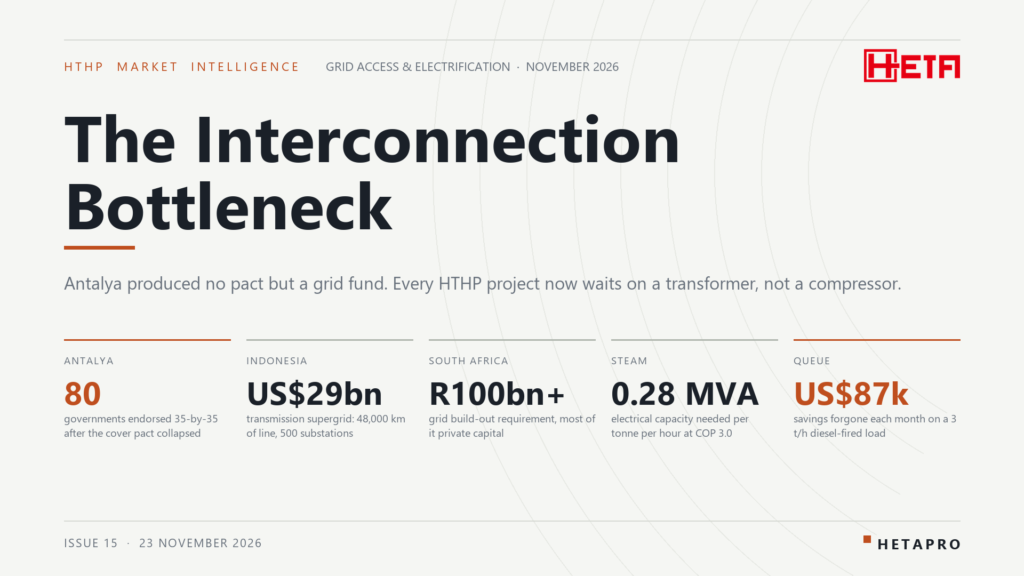

Antalya produced no pact but it produced a grid fund. Capital has moved from targets to wires — and the document that now decides your commissioning date is a connection agreement, not a datasheet.
Key takeaways
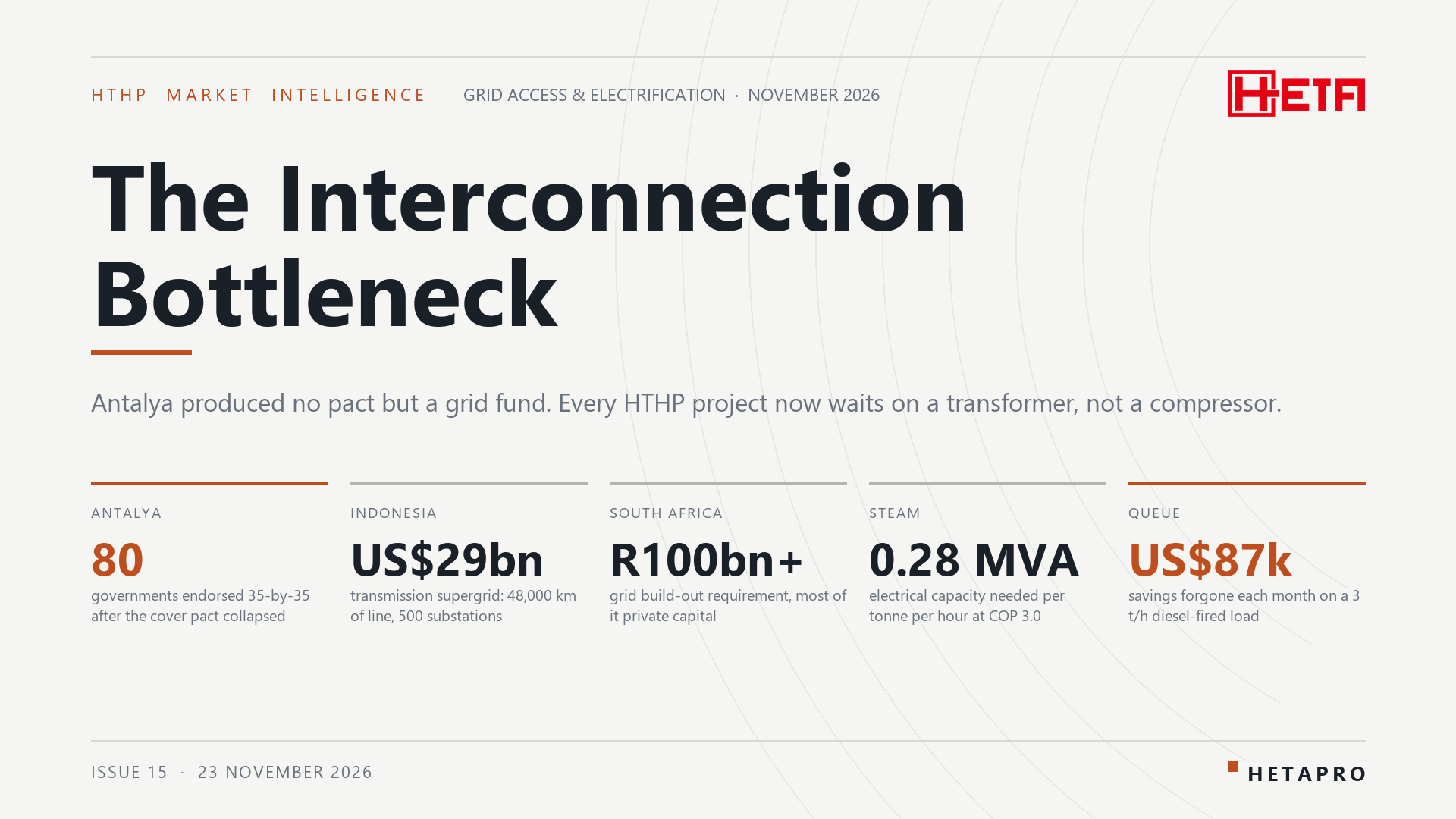
- COP31 closed in Antalya on 20 November without a cover decision after 44 hours of overtime — the longest summit on record. But about 80 governments endorsed the 35-by-35 electrification pledge, and the money survived: an Electrify Now Finance Coalition co-chaired by the World Bank and the African Development Bank from 2027, and utilities raising annual grid investment to US$156 billion.
- The wire is the new bottleneck. Indonesia's PLN priced transmission alone at US$29 billion — 48,000 km of line and about 500 substations — and South Africa's Treasury put the grid build-out requirement above R100 billion, most of it private capital.
- UM high-temperature heat pump making 6 bar(g) steam needs about 740 kWh of heat per tonne; at COP 3.0 that is roughly 0.28 MVA of connection capacity per tonne per hour. A 10 t/h load is a 2.8 MVA problem — frequently bigger than the spare capacity on the feeder.
- Storage has changed jobs. Agora Industry's 10 November study put hybrid electro-thermal storage savings at up to 70% of heat cost (Spain, €20/MWh) with paybacks near 1.5 years — and its first policy ask is simpler grid connections. In Southeast Asia, storage pays as a connection-shrinking tool before it pays as an arbitrage tool.
- Queues are priced in time. On a 3 t/h diesel-fired steam load at COP 3.0 and US$0.10/kWh, forgone savings run about US$87,000 per month; a 12-month queue adds nearly the installed cost of the unit and lifts heat pump payback from 1.1 to 2.2 years.
For two years the conversation around process heat electrification in Southeast Asia and Africa has been about prices: tariffs, fuel costs, carbon, subsidies. This week the conversation moved to capacity — not thermal capacity, not compressor capacity, but the megavolt-amperes available at the point of connection. COP31 ended without the political deal its hosts wanted. What it left behind instead was a stack of numbers about wires, and every one of them lands on the desk of whoever is specifying an industrial heat pump for a factory in Java, Johor, KZN or Nairobi.
The argument of this briefing is simple: the binding constraint on HTHP deployment has migrated from the machine (solved), to the fuel-price ratio (quantified in our previous issue), to the grid connection. A supplier who can deliver a 200°C unit in fourteen weeks cannot deliver the 1.5 MVA behind it in fourteen weeks. Whoever prices the queue wins the project.
1 · Antalya produced no pact. It produced a grid fund.
COP31 closed on 20 November 2026 after running more than 44 hours into overtime — the longest UN climate summit in history — without agreement on a cover decision. References to phasing out fossil fuels were dropped from the draft, adaptation finance stayed at the level of encouragement rather than commitment, and objections from enough parties to block consensus meant the "Antalya Pact" simply never existed. The presidency's own words at the closing plenary were an apology: "we did our best."
Beneath the wreckage, the electrification agenda walked out intact — and richer than it arrived. Around 80 national governments endorsed the Turkish presidency's 35-by-35 Global Electrification Pledge (electricity from roughly 23% of final energy consumption to 35% by 2035), 185 companies signed in support, and more than a dozen countries published new electrification or energy-access plans. Ethiopia — a named endorser — takes the baton as host of COP32 in Addis Ababa in November 2027.
Three financial instruments give the pledge something it did not have when we covered its launch two issues ago:
- An Electrify Now Finance Coalition (announced 10 November) to fund electrification in emerging and developing economies, with the World Bank and the African Development Bank as inaugural co-chairs in 2027, running through to a stock-take at COP33 in 2028. For African industrial buyers this matters more than the pledge itself: it puts the continent's principal development bank inside the room where electrification money is allocated.
- Utilities for Net Zero Alliance members raised their combined annual commitment for grids, renewables and storage from US$148 billion to US$156 billion — 89 utilities, 320 million customers, and a claimed 21,000 km of new grid built in 2025, up from 14,000 km in 2024.
- O Climate Investment Funds will deploy US$94 million of catalytic public finance through its AMPLIFi programme into five development-bank-led investments, aiming to mobilise about US$1.2 billion — including US$15 million of junior equity into a South African grid investment platform developed with the AfDB. Junior equity into grid assets is the signal: public money is now de-risking wires, not panels.
The IEA closed the week with its World Energy Outlook 2026 (19 November), reporting that 25 countries plus the European Commission have introduced new electrification policies since the 2026 Hormuz energy crisis, half of them in the Asia-Pacific region, and estimating that faster electrification would cut fuel-importing countries' energy import bills by about a quarter — roughly US$400 billion a year by 2035.
2 · Indonesia has priced the wire: US$29 billion for transmission alone
The most specific number of the week came from the Indonesia Pavilion. PLN President Director Suroso Isnandar told the COP31 panel on 9 November that the utility needs more than US$29 billion — excluding generation — to build a "green enabling supergrid": about 48,000 km of transmission line, substations totalling 8,000 MVA across roughly 500 new substations. The reason he gave is the one every ASEAN industrial energy manager already knows from their own switchboard: "the mismatch between the locations of renewable energy resources and centres of electricity demand." Generation, storage and transmission, he added, must be developed "in a coordinated way, taking into account the locations and schedules of industrial electricity demand."
That sentence deserves to be read twice by anyone siting a heat pump. The utility is explicitly inviting industrial demand to declare its location and schedule so the wire can be planned around it. The surrounding programme is large enough to make the invitation credible:
- Six international partners — the World Bank, KfW, ADB, AFD, the Australian government and JICA — committed US$2.94 billion during COP31 to accelerate clean energy and grid development.
- The 2025–2034 RUPTL requires about Rp2,967 trillion (over US$180 billion) to add 69.5 GW, of which roughly 76% is renewables plus storage — and includes about 89.1 GWp of grid-connected solar within President Prabowo's 100 GWp solar programme.
- An initial procurement package of 30.5 GW of solar and 61.4 GWh of batteries is due to be announced "in the coming weeks."
- PLN also confirmed it will sign a Mitigation Outcome Purchase Agreement with Norway covering up to 5 MtCO2e through 2040 — a second, smaller Article 6.2 channel alongside the 12 Mt deal we reported last issue.
3 · South Africa: the constraint moved from megawatts to megavolt-amperes
South Africa supplied the week's clearest confirmation that load-shedding was never the final chapter. On 11 November at the Old Mutual "Tomorrow" investment summit in Cape Town, Treasury Director-General Duncan Pieterse said the national grid needs more than R100 billion of expansion and modernisation, "most of which will need to come from private investors," and named the grid itself as the new constraint on the private renewable investment that has carried the transition so far. He paired the number with an institutional ask: the National Transmission Company South Africa (NTCSA) should become an independent system operator offering open, non-discriminatory grid access.
Two days later, Eskom convened IPPs and market participants at Megawatt Park for a two-day session pointedly titled "From Reform to Resilience" (12–13 November), reviewing grid development plans with Eskom Distribution and NTCSA, capacity bottlenecks, and — the phrase that matters to industrial connections — maximising the use of existing grid capacity.
The backdrop has genuinely improved: 546 consecutive days without load shedding as of mid-November, seven of nine provinces free of load reduction. But BloombergNEF's South Africa Transition Factbook 2026 frames the new problem precisely: corporate PPAs are set to support 73% of the 2.3 GW of solar and wind additions expected in 2026 — more than government auctions for the first time — while transmission capacity emerges as the limiting factor. And for the heat-pump business case, it adds two numbers worth taping to a wall: industrial electricity averaged R1,652/MWh in 2025 against R964/MWh in mainland China, and industrial decarbonisation is now "a competitiveness issue, not just an emissions issue" because of CBAM.
4 · Storage changed jobs: from tariff tool to connection tool
On 10 November, mid-summit, Agora Industry published a 70-page study with Fraunhofer ISI, Unlocking industrial flexibility with thermal storage, covering Germany, France and Spain and three use cases: steam for paper, low-temperature steam for food, and high-temperature heat treatment in steel. The headline numbers: pairing existing heating systems with electro-thermal energy storage (ETES) — electricity stored as heat in rock or sand — cuts industrial heat costs by up to 70% (a hybrid system in Spain reaches €20/MWh; France about €30/MWh with emissions down 74%; Germany about €60/MWh), electrification rates reach about 75% in Spain and France with paybacks around 1.5 years, and the savings come primarily from trading electricity flexibly across day-ahead, intraday and balancing markets.
The more useful finding for our region is buried in the policy asks: faster and simpler grid connections, grid fees that reward rather than penalise flexible consumption, and access to flexibility markets. Translated for a Thai or Vietnamese or Kenyan plant, where intraday and balancing markets barely exist: storage's first job is not arbitrage. It is connection sizing.
The mechanism is straightforward. A heat pump sized to meet peak steam demand draws peak electrical demand for a few hours a day; a heat pump that charges a thermal buffer through the night and lets the buffer carry the morning peak can run flatter, closer to its best COP, and reserve markedly less kVA. As a rule of thumb, spreading a steam load over 12 hours of machine runtime instead of 8 cuts the reserved electrical capacity by roughly a third. Last issue we concluded that thermal storage struggles to pay as pure TOU arbitrage in ASEAN because 170°C-class storage costs above US$50/kWhth. That conclusion stands — for arbitrage. Against a connection upgrade or a demand charge, the same tank competes against R100bn-class grid capex and 12–24 month lead times, and often wins.
5 · The machines are getting hotter — and smaller
The supply side moved in the same week, in the direction the grid argument needs. Cannon Bono launched a modular high-temperature heat pump range delivering steam up to 115°C at 1.7 bara in blocks of 300 kW to 4 MW; a reference installation at an Italian specialty paper mill produces 1,200 kg of steam per hour at COP 5.25 using refrigerant with GWP below 5. Austria's ecop, meanwhile, is raising a €10 million B+ round (after a €15 million Series B led by KSB) for its rotary heat pump, which reaches 200°C with a 100 K temperature lift at COP 3–4 on inert-gas mixtures with GWP and ODP of zero — two GEN3 units are being commissioned at a German district-heating demonstration by end-2026. And the Chinese Academy of Sciences Guangzhou institute commissioned a "zero-steam" 140°C heat-pump-plus-storage energy centre at a Coca-Cola bottling plant, which has run the whole site over 30 days without purchased steam, pairing a large-tolerance high-temperature heat pump with staged thermal storage and 6°C chilled water from the same machines.
Read these three together against the grid argument. Modular blocks in the 300 kW–4 MW range can be staged to fit whatever MVA the utility will actually give you this year — start with the block the feeder allows, add blocks as the connection grows. The 200°C class is genuinely important for ceramics and chemicals, but at COP 3–4 across a 100 K lift its electrical footprint per tonne of output is half again as large as a 115°C machine's; the hotter the machine, the heavier the wire. And the zero-steam bottling plant is the existence proof that the heat-pump-plus-storage configuration from section 4 works at industrial scale — just not yet anywhere with a weak grid, which is precisely where most of the region's diesel and LPG boilers are.
6 · The number the utility sees
Strip away the policy and an industrial heat pump presents the utility with a single number: kVA at the meter. It can be computed before anyone quotes a machine. Saturated steam at about 6 bar(g) carries roughly 740 kWh of heat per tonne above 25°C feedwater. Divide by COP for electricity, correct for power factor and auxiliaries, and you get the electrical footprint:
kVA ≈ (tonnes/h × 740 kWhth/t ÷ COP) × 1.08 auxiliaries ÷ 0.95 power factor
1 t/h at COP 3.0 → 740 kWth → 247 kWe → ≈ 281 kVA
rule of thumb: ≈ 0.28 MVA per tonne per hour of steam
Table 1 turns that rule into the numbers a utility planner will ask for. Note what the table is really saying: most candidate boiler replacements in the region are 2–5 t/h, which places the request between 0.6 and 1.8 MVA — commonly more than the headroom left on a feeder that also carries the factory's compressors, chillers and motors.
| Steam load | COP 2.4 (large lift, 165°C class) | COP 3.0 (120–160°C class) | COP 3.8 (115°C class) | COP 5.0 (low-lift waste-heat recovery) |
|---|---|---|---|---|
| 1 t/h | 350 kVA | 281 kVA | 221 kVA | 168 kVA |
| 3 t/h | 1,051 kVA | 841 kVA | 664 kVA | 505 kVA |
| 5 t/h | 1,752 kVA | 1,401 kVA | 1,107 kVA | 842 kVA |
| 10 t/h | 3,504 kVA | 2,803 kVA | 2,213 kVA | 1,684 kVA |
Two footnotes belong on this table. First, motor inrush: soft starters or VFDs are not optional at these sizes, and utilities increasingly specify harmonic limits (THD) that the drive package must meet — budget for them. Second, the auxiliary factor is honest, not pessimistic: pumps, cooling for the heat sink, controls and the evaporator's own parasitics realistically add 6–10%.
7 · Five ways to fit inside the wire you already have
The premise of this briefing is that the connection is a design variable, not a given. Table 2 ranks the strategies by how fast they move a commissioning date, which — in a queued system — matters more than how they move the capex line.
| Strategy | Typical lead time | Effect on required kVA | Cost signal | Main risk |
|---|---|---|---|---|
| Load swap — retire boiler fans, diesel gensets, old chillers from the demand register | 1–3 months | Frees 10–30% of reserved capacity without new infrastructure | Near-zero capex | Utility may re-rate the connection and reclaim the headroom |
| Modular staging — 250–500 kWth blocks sized to available headroom | 3–6 months per block | Each block stays inside the existing service; capacity grows with the connection | +5–8% on $/kWth | More floor space, more connection points to administer |
| Thermal buffer — hot water or rock storage to flatten the electrical load | 4–8 months | Cuts reserved kVA 30–50% by spreading machine runtime | US$40–120/kWhth installed | Footprint; above ~170°C the cost climbs sharply |
| MV connection — dedicated transformer at 11–20 kV instead of the LV board | 9–24 months | Unlocks the full load; often the only path above ~1 MVA | US$80–250k plus study fees | The queue itself; transformer lead times of 12–24 months are commonly quoted in the region |
| Captive solar + storage — behind-the-meter generation to offset the new load | 6–12 months | Reduces import kVA at the hours that set the demand charge | High capex; land and permits | Daytime-only unless buffered; interconnection rules vary |
One contrarian note belongs here, because it will save somebody a wasted quarter: an ESCO does not solve the interconnection problem. Under build-own-operate and heat-as-a-service structures the electrical load remains metered at the host facility; the kVA lands on the host's connection whoever owns the compressor. What a third-party structure can do is finance the connection upgrade alongside the machine and carry the performance risk while the plant runs months on a partial connection. That is worth having — but it is a financing answer, not a capacity answer.
8 · The cost of queuing
Queues are priced in time, and time is priced in forgone savings. The worked example below is the configuration this newsletter keeps returning to because it is where the money actually is in Southeast Asia and Africa: a diesel-fired steam boiler, at a plant running 6,000 hours a year.
Boiler heat cost: US$0.95/L ÷ 9.96 kWh/L ÷ 0.85 efficiency = US$112/MWhth
HTHP heat cost: US$0.10/kWh ÷ COP 3.0 = US$33.3/MWhth
Saving: US$78.9/MWhth × 0.74 MWhth/t = US$58.4 per tonne of steam
Annual: 18,000 t/yr × US$58.4 = US$1.05 million per year
≈ US$87,600 of savings forgone for every month of queue
Against annual savings of US$1.05 million, a machine costing about US$1.1 million installed looks like a 1.05-year payback. Now add the wire. A 12-month connection queue contributes US$1.05 million of forgone savings — roughly the installed cost of the machine itself — plus, say, US$180,000 for the MV upgrade and its studies:
Payback = (Capex + Connection cost + Queue × monthly savings) ÷ Annual savings
= (1.10 + 0.18 + 12 × 0.0876) ÷ 1.05 = ≈ 2.2 years — double the naive number
Two consequences follow. First, every month of queue is a month of capex, which reframes what a "free" connection study is worth and how hard you should push for a load swap or a staged block that starts saving while the MV upgrade grinds through its own timeline. Second, partial-connection operation is a real commercial state, not a compromise: a plant given 0.5 MVA of a needed 0.85 MVA can run the first heat pump block at 60% of design for eighteen months, bank the savings, and self-fund the balance of the upgrade. The option to phase is worth demanding at contract stage — see the checklist below.
9 · What to do in the next 90 days
- Pull the demand register before specifying any machine. Twelve months of maximum demand at the shortest interval available, plus the transformer nameplate and its loading history. The kVA table above turns this into a go/no-go in an afternoon.
- Book a pre-application connection meeting this month. Ask one question in writing: what kVA is available at our point of connection, and what is our queue position if the answer is zero? In Indonesia, ask how the plant's electrified load can be reflected in RUPTL demand planning; in South Africa, open the Eskom/NTCSA access conversation in parallel with any wheeling application.
- Specify modular blocks, not a monolith. 250–500 kWth units at 115–140°C, staged to the connection you can actually get in 2027, with the electrical design pre-approved for the next block.
- Price the storage buffer against the demand charge and the queue, not the tariff spread. In markets without intraday trading, the tank's job is to flatten the load and shrink the reserved kVA.
- Make the connection date a condition precedent. Contracts should carry a staged commissioning schedule tied to the utility's own milestones, with savings shared pro-rata during any partial-connection period.
- Meter fuel and power per functional unit from day one. CBAM's first declaration is due 30 September 2027, Article 6 channels in Indonesia and Vietnam will pay only for measured abatement, and the utility will want the same interval data for the demand study. One metering design serves all three masters.
- Track the compliance clock where it applies. Malaysia's Energy Efficiency and Conservation Act 2024 binds consumers above 21,600 GJ (6,000 MWh) a year to registered energy managers, EnMS and mandatory audits — an electrified steam load moves plants toward that threshold, not away from it. The Philippines' DOE–ERIA cooperation signed on 15 November (covering ASEAN Power Grid studies and industrial decarbonisation) and UNIDO's Mindanao industrial energy-efficiency market assessment (bids close 27 November) are the two live channels through which donor money is currently reaching exactly this project type in ASEAN.
10 · Six questions buyers are asking this week
How much electrical capacity does an industrial heat pump need per tonne of steam?
About 740 kWh of heat per tonne of 6 bar(g) steam above 25°C feedwater. At COP 3.0 that is 247 kWh of electricity, or roughly 281 kVA after power factor and auxiliaries — the 0.28 MVA per tonne-hour rule in Table 1. A 3 t/h boiler replacement is a 0.85 MVA request; 10 t/h is 2.8 MVA.
Why is the grid connection now the critical path for a high-temperature heat pump project?
Because the capital and the utility planning cycles converged on wires this month: the Electrify Now Finance Coalition under the World Bank and AfDB, Indonesia's US$29 billion transmission programme, South Africa's R100 billion grid requirement, and utility commitments of US$156 billion a year. Machines ship in weeks; transformer and switchgear lead times are commonly quoted at 12–24 months, and the studies precede them. The connection, not the compressor, sets the commissioning date.
Can thermal storage reduce the connection an industrial heat pump needs?
Yes — and in our region that is its best-paying job. Spreading machine runtime across a thermal buffer cuts reserved kVA by roughly 30–50% and keeps the compressor near its design COP. Agora's November 2026 study puts hybrid ETES savings at up to 70% of heat cost in Spain with ~1.5-year paybacks, and lists simpler grid connections as the first condition for scaling. Without day-ahead and balancing markets, the value shifts from arbitrage to demand-charge avoidance and connection sizing.
Does an ESCO or heat-as-a-service contract remove the connection problem?
No. The load stays metered at the host's connection whoever owns the machine — third-party structures solve capex, not kVA. What they can do is finance the connection upgrade with the machine and carry performance risk during partial-connection operation. Ask for both explicitly.
What actually happened at COP31, and does it change the business case?
No cover decision, after 44 hours of overtime. But ~80 governments endorsed 35-by-35, the finance coalition runs to COP33 in 2028, and the IEA counts 25 countries with new electrification policies since the Hormuz crisis. It changes the cost of capital and the priority your connection request receives; it does not change the arithmetic between your meter and your boiler. That ratio — COP × fuel price ÷ boiler efficiency — is unchanged since last issue.
What is connection-adjusted heat pump payback and why quote it?
Equipment cost plus connection cost plus forgone savings during the queue, divided by annual savings. In the worked example above it doubles payback from 1.1 to 2.2 years on a 12-month queue. Quoting it forces the utility conversation to happen at contract stage — where it can be managed — instead of at commissioning stage, where it can only be absorbed.
Conclusion: the treaty failed, the queue did not
There is a comfortable story available this week: COP31 collapsed, so nothing happened, so the case for waiting is intact. It is also wrong. What collapsed was the part of the climate process that was never going to sign a purchase order. What survived — the AfDB-co-chaired coalition, the US$156 billion of utility commitments, Indonesia's 48,000 km, South Africa's R100 billion — is the part that decides whether a factory's electrified steam load gets a wire, and when.
For the buyer, the week's lesson fits in one sentence: an industrial heat pump is a grid connection wearing a machine. Specify the 0.28 MVA per tonne-hour alongside the COP. Ask for the queue position before the quota for the compressor. Stage the blocks to the feeder. Let the thermal buffer do the work it is actually priced for. And when the connection study comes back with a date twelve months out, price it honestly — at US$87,600 a month on a 3 t/h diesel load — and use that number to buy the load swap, the partial connection or the storage buffer that starts the savings now.
The machines are ready and the money has arrived. The bottleneck is administrative, which is the best kind of bottleneck: it yields to paperwork filed early.