
Topics: high temperature heat pump (HTHP) · industrial heat pump · waste heat recovery · steam generating heat pump · process heat electrification

Key takeaways
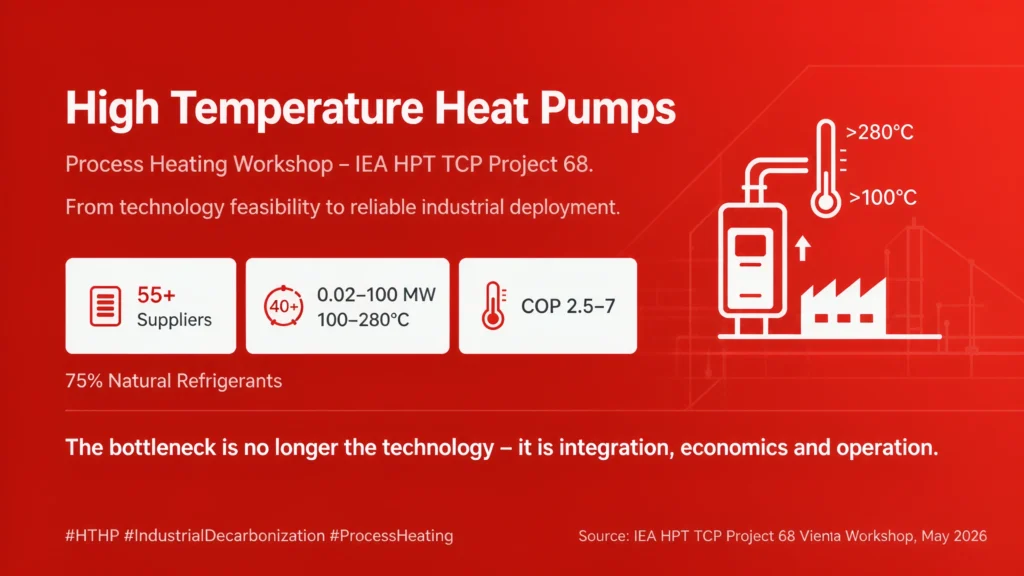
- IEA HPT TCP Project 68 now tracks 55+ HTHP technology platforms across 14 countries, with capacities from 30 kW to 70 MW and supply temperatures up to 280 °C. [2](@ref)
- About 75% of reviewed HTHP platforms use natural refrigerants — CO₂, ammonia, hydrocarbons, water/steam. [12](@ref)
- Commercial maturity is strongest at <130 °C; 130–160 °C is moving from demo to roll-out; >160 °C remains project-specific. [12](@ref)
- Typical HTHP COP is 2.5–4.0 at 100–150 °C; COP is set by temperature lift, not by headline marketing claims. [1](@ref)
- The bottleneck is no longer the compressor — it is process integration, reliable waste-heat data, electrical connection and lifecycle O&M. [7](@ref)
- Payback follows the formula: (electricity price ÷ fuel price) ÷ COP + incentives + carbon value − integration cost.
A high temperature heat pump (HTHP) is no longer a laboratory curiosity. After the IEA HPT TCP Project 68 workshop at the 15th IEA Heat Pump Conference in Vienna, the consensus among equipment suppliers, EPCs and end-users was clear: the technology is ready for industrial process heat up to ~160 °C, and the real question is how to integrate it into a factory without destroying the business case. [7](@ref)
This guide rewrites that workshop into an SEO-ready reference for buyers, specifiers and content teams. It covers definitions, maturity bands, COP behaviour, refrigerants, applications, policy levers and a practical checklist before you request a quote.
What Is a High Temperature Heat Pump?
An industrial heat pump (IHP) recovers low-grade heat from process water, exhaust air, flue gas or wastewater and upgrades it to usable process heat. A high temperature heat pump (HTHP) is the subset that delivers supply temperatures above roughly 100 °C.
Temperature bands that matter in 2026
- <100 °C — mature, often commercial HVAC/heat-pump water heaters and low-temp process hot water.
- 100–130 °C — standardized industrial HTHP products; strongest bankability. [12](@ref)
- 130–160 °C — modular custom systems, steam at low pressure, food/chemical/paper drying. [12](@ref)
- 160–200 °C+ — demonstrations, cascade cycles, steam compression, Brayton cycles. [2](@ref)
- Up to 280 °C — reference installations in Project 68 database, mostly custom. [2](@ref)
IEA Project 68: Where HTHP Stands Today
Project 68 runs from 2025 to 2028 and builds on Annex 58. Its value is that it separates hype from installed reality. [12](@ref)
Supplier landscape
- 55+ technology platforms tracked. [12](@ref)
- Capacity range: 30 kW – 70 MW. [2](@ref)
- Supply temperature: 100–280 °C. [2](@ref)
- Investment cost: broadly €200–1,500/kW, rising with temperature and customization.
Four conclusions from the Vienna workshop
- Natural refrigerants are now dominant. Around 75% of platforms use CO₂ (R744), ammonia (R717), hydrocarbons or water/steam (R718). For almost every HFO-based HTHP, a natural-refrigerant alternative exists. [12](@ref)
- Maturity is tiered. Below 130 °C is productized; 130–160 °C is demo-to-commercial; above 160 °C is still engineering-led. [12](@ref)
- Demonstrations are scaling. Single installations up to 40 MW are appearing; reference cases reduce perceived risk. [2](@ref)
- Integration beats hardware. The repeated barriers were process-data quality, retrofit of heat distribution, integration share of total cost, and early alignment between user, supplier, grid and permitting. [7](@ref)
HTHP Performance: COP vs Temperature Lift
The single most misunderstood metric is COP. A high temperature heat pump does not have “a COP” — it has a COP curve against temperature lift (sink temperature minus source temperature).
| Supply temperature | Typical lift | Typical COP | Use case |
|---|---|---|---|
| 100–130 °C | 40–70 K | 3.0–4.0 | Process hot water, pasteurization |
| 130–160 °C | 60–90 K | 2.5–3.5 | Drying, low-pressure steam |
| 160–200 °C | 80–120 K | 2.0–2.8 | Steam generating HTHP, MVR |
| 200 °C+ | 100 K+ | 1.5–2.5 | Custom industrial demonstrators |
Review literature places commercial HTHP COP around 2.5–4.0 for 100–150 °C outputs, with advanced low-GWP configurations reporting up to 6.10 at favourable lift. [1](@ref) The practical rule:
Refrigerants and Cycle Types
- R744 / CO₂ — transcritical water heating, good mid-temp range.
- R717 / ammonia — high efficiency, industrial safety controls required.
- R290 / hydrocarbons — used in modular HTHPs, flammable-class design.
- R718 / water-steam — very high temperature lift, steam compression.
- HFO blends — still present, but losing share under F-gas pressure.
Cycle architecture usually matches the temperature target:
- Single-stage — moderate lift, 100–120 °C.
- Two-stage / economizer — better part-load and higher lift.
- Cascade — two loops, common for 150–200 °C.
- Steam compression / MVR — open-cycle steam upgrade, very high COP when lift is small.
- Brayton cycle — pilot/demo for large glide drying air. [7](@ref)
Where HTHPs Actually Pay Back
Lead applications
- Food & beverage — pasteurization, cleaning-in-place, drying. [12](@ref)
- Chemicals & pharma — reactor heating, solvent evaporation, sterile steam.
- Pulp & paper — dryer supply air, white-water heat recovery.
- Textiles — dyeing, finishing, hot-water loops.
- District heating — 120 °C network supply from waste heat. [12](@ref)
Steam-generating heat pumps
A steam generating heat pump (SGHP) replaces low-pressure boiler steam by upgrading waste heat into saturated or slightly superheated steam. It works best when the plant already has a 60–80 °C waste stream and needs low-pressure steam, not high-pressure mains steam. [6](@ref)
The Economics: Why Policy Moves HTHP More Than Hardware
IRR ≈ f( (electricity price ÷ fuel price) ÷ COP ) + capex subsidy + tax shield + carbon revenue − integration cost
That means the same machine can be attractive in Thailand with a Direct PPA, marginal in a market with cheap gas and 17¢/kWh electricity, and excellent in Europe with carbon pricing and heat-auction support. [14](@ref)
| Lever | Effect on HTHP project |
|---|---|
| Electricity tariff / DPPA | Lowers denominator of energy saving |
| Gas / fuel price | Raises saving per kWh heat |
| COP at real lift | Determines electric input |
| Carbon price / CBAM | Adds revenue or avoided cost |
| Tax deduction / green loan | Improves capex payback |
| MEPS & certification | Gates market entry, favours compliant OEMs |
| Integration scope | Often 30–80% of total installed cost |
Policy signals worth tracking
- EU IF26 Heat Auction — EUR 1 bn, heat pumps named, threshold lowered to >80 °C. [14](@ref)
- Vietnam — green taxonomy, 2% interest-rate subsidy for certified equipment. [14](@ref)
- Thailand — 150% tax deduction for DEDE 5-star equipment, industrial Direct PPA. [14](@ref)
- Kenya — open-access power rules, industrial tariff reform. [14](@ref)
- F-gas / MEPS trends — push HFO platforms toward natural refrigerants.
Market Size Snapshot
The broader high temperature heat pump market is forecast at USD 4.5 bn in 2026 → USD 8.0 bn by 2033 (8.6% CAGR), led by Europe and accelerated by Asia Pacific industrialization. [3](@ref) The narrower ≥100 °C industrial HTHP segment is growing faster — one forecast puts it near 15% CAGR to 2032 — because that is where boiler replacement economics are clearest. [8](@ref)
- Largest region: Europe (policy + district heating). [3](@ref)
- Fastest region: Asia Pacific (China/India process industry). [3](@ref)
- Top application: industrial process heating (>50% revenue). [3](@ref)
- Top end-use: chemicals & food/beverage. [8](@ref)
Buyer Checklist Before Specifying an HTHP
- Define the real sink temperature. Do not specify 160 °C if 130 °C meets the process.
- Map the heat source. Temperature, flow, fouling risk, continuity — this sets COP.
- Ask for COP at your lift. Not catalogue COP at 60 K lift.
- Count integration cost. Pumps, controls, heat exchangers, electrical upgrade, civil works.
- Check refrigerant path. Natural refrigerant + local service partner reduces future compliance risk.
- Model incentives explicitly. Tariff, carbon, tax, subsidy, depreciation.
- Require sub-metering. Source kWh, sink kWh, electric kWh, runtime, part-load.
- Align stakeholders early. Plant engineer, energy manager, grid, OEM, integrator.
Frequently Asked Questions
What is the difference between IHP and HTHP?
An industrial heat pump (IHP) upgrades waste or ambient heat for industrial use. A high temperature heat pump (HTHP) is the subset delivering above ~100 °C. All HTHPs are IHPs; not all IHPs are HTHPs.
What COP should I expect from a high temperature heat pump?
For 100–150 °C, typical COP is 2.5–4.0. Advanced systems report up to 6.1 at low lift. Above 160 °C, COP often falls to 2.0–2.8 unless the source is warm and the lift is small. [1](@ref)
Can an HTHP replace steam boilers?
Yes for low-pressure steam and process hot water. High-pressure steam (>10–15 bar) is still difficult for compression HTHPs and usually needs MVR, cascade cycles or hybrid boiler backup. [6](@ref)
Which refrigerant is best for HTHP?
There is no single answer. CO₂ fits transcritical hot water; ammonia fits large industrial systems; hydrocarbons fit modular units; water/steam fits high-temp steam compression. Natural refrigerants now cover most HTHP duties. [12](@ref)
How mature is HTHP technology in 2026?
Below 130 °C: commercial. 130–160 °C: demonstrators moving commercial. Above 160 °C: custom projects. Project 68 confirms the supplier base is large enough for most sub-160 °C industrial cases. [2,12](@ref)
Conclusion
The 2026 story for high temperature heat pumps is not “does it work” — it is “does the integration and incentive stack work”. IEA Project 68 shows the equipment is ready: 55+ platforms, natural refrigerants dominating, demonstrations past 200 °C, COP curves well understood. [2,12](@ref)
Buyers who win are the ones who specify by real temperature lift, budget for integration, choose future-proof refrigerants, and model the project with electricity tariff, carbon value and local incentives included — not just a COP number on a datasheet.
Sizing a high temperature heat pump for an industrial site?
HETAPRO supports HTHP selection for process hot water, low-pressure steam and drying applications. Send the source temperature, target supply temperature, hourly heat demand, and local electricity/fuel tariffs.
We return an indicative HTHP configuration, COP estimate at your lift, natural-refrigerant option, and a payback model that includes applicable incentives.